Let’s Talk About Female Fantasies
What do you fantasize about when you want to heat things up in bed? What can make you come in a split second? What turns you on? What do you crave, lack, desire? And how do you feel after the rush of orgasm, once the fantasies recede? Shameful? Happy? Relieved?
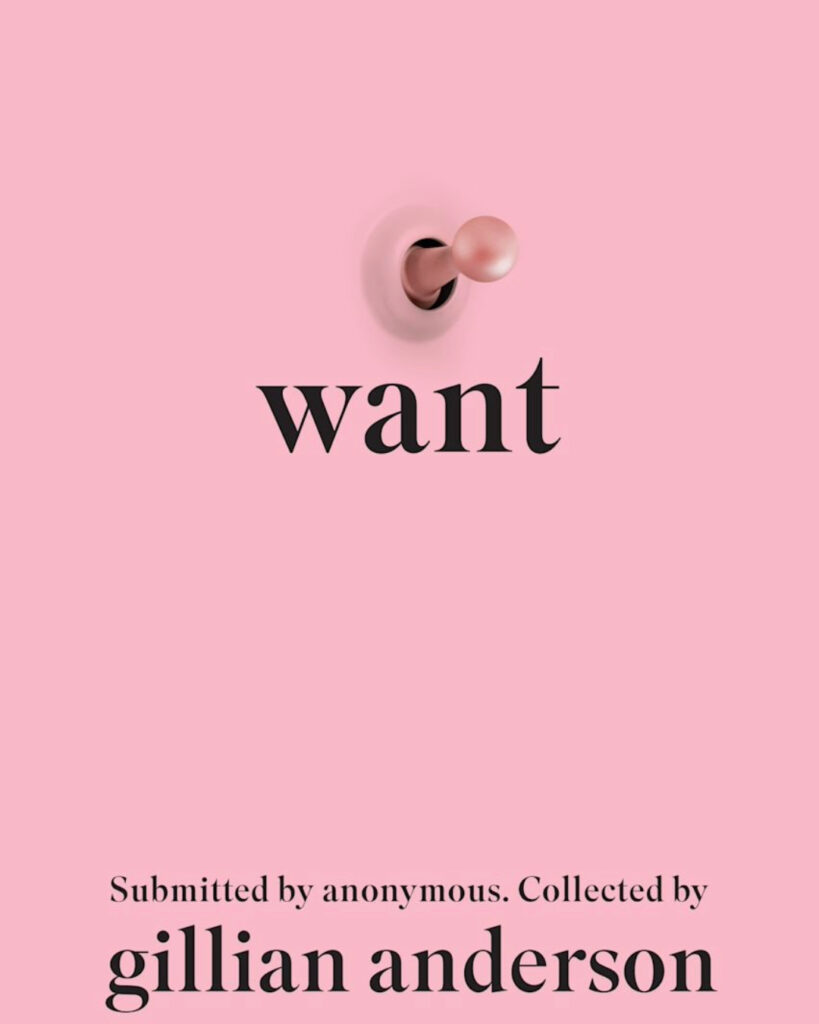
Want by Gillian Anderson is a collection of 174 anonymously submitted letters from women describing their sexual fantasies. It is not merely porn in print, nor a literary version of Pornhub. Rather, it reads as a sociological study that invites the reader into the intimate inner worlds of women. Each letter is accompanied by social data about its author: age group, ethnicity, country, annual salary range, marital status, sexual orientation, and whether they have children. This contextual framing turns the book into something like a dataset, allowing readers to notice patterns and correlations between fantasy and lived reality. For example, one detail that stood out to me was that women who identified as Jewish reported annual salaries ranging between £100,000 and £400,000, while many other ethnic groups clustered between £15,000 and £40,000. More broadly, salary ranges varied significantly across ethnicities and countries, subtly shaping how desire, power, and freedom appear in the fantasies themselves. That said, I will not bore you with qualitative data analysis here.
The book is divided into chapters organized by mood, grouping together letters of a similar emotional or erotic character. Some chapters focus on kink, others on tenderness, longing, or romantic devotion. This structure does more than neatly organize the material. It turns the book into a kind of mood atlas. You do not just read it but enter a particular emotional and erotic space.
At one point, when my girlfriends were staying over, I told them I was reading Want and suggested that each of us choose a letter to read aloud. We each gravitated toward different chapters that reflected our own desires. I chose one centered on kink, one friend picked a letter about gentleness and love while another chose a chapter which revolved largely around gangbang fantasies. The experience underscored one of the book’s quiet strengths – validating the vast range of female desire without hierarchy or judgment.
Every letter reads like a journal entry, granting access to the emotional worlds of these women. I would like to talk about those letters that really stuck with me for different reasons. However, I would like to remind you that those are merely my own subjective interpretations, you can either agree with them or not.
Letter 1: Rape Fantasies
In some letters, women who are survivors of sexual abuse describe feeling unworthy of love. Their private lives are marked by pain, while their sexual fantasies revolve around being loved, cared for, and seen as beautiful. In contrast, other letters come from women who openly and often shamefully admit that despite identifying as feminists in their everyday lives, they reach orgasm by fantasizing about being raped.
Those particular letters reminded me of Virginie Despentes’s discussion about women’s rape fantasies in King Kong Theory. Despentes situates these fantasies within a framework shaped by religious upbringing and the symbolic legacy of Judeo-Christian culture, where female sexuality has historically been associated with sacrifice, suffering, and submission. Rather than attributing such fantasies to biology or innate desire, she argues that they are culturally produced. In this system, pleasure is often learned through powerlessness, and desire becomes entangled with self-erasure rather than autonomy. Her analysis raises particularly unsettling questions when considering women who have experienced sexual violence and also harbor rape fantasies. Instead of offering a resolution to this contradiction, Despentes insists on its irresolvability. The subject remains largely silenced because articulating it threatens to reveal how deeply female desire has been shaped by patriarchal structures. What remains unsayable is therefore deeply destabilizing: it exposes that women’s sexuality is not purely personal or freely chosen but formed within a logic that repeatedly distances women from power.
This perspective may offer an interpretive explanation for why some women in Want, who do not specify whether they have a history of abuse, nonetheless describe violent fantasies. As I observed, many of these women report annual incomes of around £40,000, which in today’s economy places them solidly within the middle class (unless one lives in the United States). In contemporary capitalism, money often functions as a form of power; these women, many of whom also identify as feminists, appear to be economically and socially empowered, with a strong sense of ownership over their lives. Psychological discourse often suggests that women who occupy positions of strength and control may seek the opposite in intimate settings. Submission, powerlessness, and the relief of being told what to do can become erotic precisely because they contrast so sharply with everyday autonomy. Yet consent plays a crucial role here, which makes the enjoyment of fantasies centered on non-consensual violence particularly intriguing. If consent is present in the fantasy’s framing, what, then, is the source of pleasure in imagining its absence? This unresolved tension is perhaps one of the most provocative questions Want leaves open.
Letter 2: Lesbians Fantasizing About Men
Another striking letter, of which there is more than one, comes from a lesbian woman who fantasizes about sex with men. Even within the letter, a sense of confusion is palpable as she is certain of her being attracted to women, yet during intimacy with her girlfriend, she reaches orgasm only by imagining men inside her. After doing some research, as I was genuinely confused, I concluded that this tension could be read through the distinction between sexual orientation and erotic orientation. Sexual orientation refers to whom one loves, desires, and builds emotional or relational bonds with, while erotic orientation describes the imagery, power dynamics, or bodies that trigger arousal and fantasy. As sexologists and queer theorists have long noted, these two do not always align. In this case, the letter exposes how fantasy does not necessarily undermine identity but instead reveals the complexity of desire – one that resists neat categorization and challenges the assumption that lesbian sexuality must be erotically exclusive to women.
Letter 3: Impotent Husband and Male Egocentrism
One of the saddest letters comes from a middle-aged woman married to an impotent husband whose ego is so fragile that he refuses to pleasure her in any other way. Deprived of intimacy, she retreats into fantasy to feel like a woman again, to feel loved, wanted, and desired. The letter ends with her quiet resignation: she seems to believe she will never have sex again. I remember wanting to scream at her “just divorce him” but who am I to judge? Still, this letter stayed with me, and it made me angry. It exposes, once again, how deeply male egocentrism can structure heterosexual relationships.
From a psychological perspective, her response can be read through the lens of learned helplessness (Seligman, 1975), where prolonged emotional deprivation leads individuals to accept situations they might otherwise resist. Feminist psychologists have also pointed to sexual script theory (Gagnon & Simon, 1973), which explains how women are often socialized to prioritize male ego, comfort, and identity over their own sexual needs. In long-term heterosexual relationships, this can result in women internalizing the belief that desire fades naturally or worse, that their own pleasure is expendable. Fantasy, then, becomes not a supplement to sex but a substitute for it, a private space where agency, desire, and recognition can still exist. What makes this letter particularly painful is not only her loneliness, but her acceptance of it. Her story illustrates how emotional neglect, when normalized, can be as silencing as overt abuse.
Letter 4: Just Hug Me
The final letter I remember lingered with me not for what it provoked intellectually, but for how quietly it undid me. It was about a girl being fed chocolate by the Hogwarts potion master, who then wraps her in his arms and tucks her into sleep. That was all. No explicit sexuality, no urgency, only care. Only warmth. Only the simple, aching wish to be held. The fantasy unfolded with such tenderness, with such attentive detail, that its warmth seemed to leak beyond the page and settle into my room. Reading it, I felt myself soften. I felt exposed. A small, sudden sadness surfaced, the realization that it had been a long time since I had allowed myself to be that gently vulnerable with someone, to rest inside another’s care without needing to perform, explain, or desire anything more.
Conclusion
I would say that this is a book everyone should keep on their bedside table, to dip into whenever the mood strikes. It opens doors to countless worlds of fantasy and invites the reader to turn inward, to examine their own desires with curiosity rather than judgment. Reading it, I found myself observing my reactions closely. Which fantasies stirred me, which left me untouched, and why. The experience was as revealing as it was surprising. It is astonishing how different, complex, and rich we women are, and how desire, in all its forms, refuses to be simplified or unified.
I wish you a fiery and wet read. Enjoy!