Validity of Anger and Sheriffs of Morality
by Ani Tenieshvili
I dreamed I was a seagull, soaring over the city.
Nowadays, I only return to my childhood home in my dreams. In Batumi, the roof of the Soviet apartment block across from my old house was the primary sanctuary for seagulls-and perhaps it still is. I remember their cries could only be heard when it rained; when the torrential downpour drowned out the city’s industrial noise, giving their protest a stage. That sound was simultaneously a warning and an act of rebellion.
I no longer live there, but in my memory, I often return to my sixth-floor balcony. The courtyard below with its parking spots and its church was a miniature illustration of our country’s social body. Those of us born in the 90s lacked many things, but one thing was forged clearly into our skin: a sharp sense of injustice. We first tested this when the “big boys” in the courtyard established a monopoly over our only playground – the yard. Right under my balcony, they hung a basketball hoop on a garage and refused to let us – little girls – play.
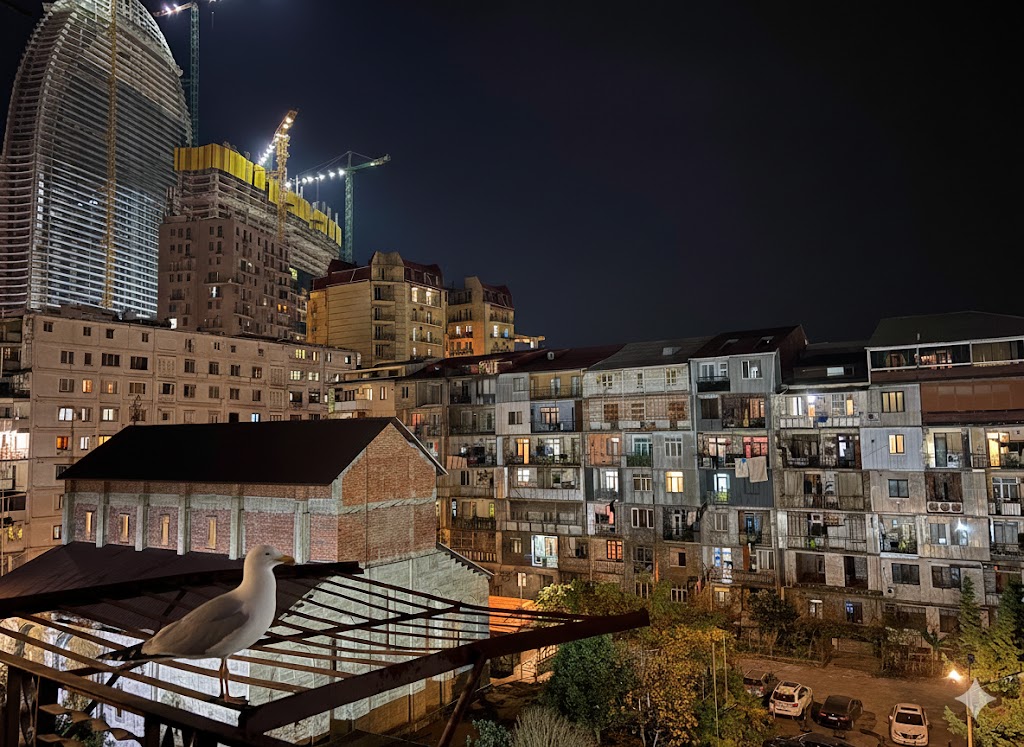
© Ani Tenieshvili
It was there, on that sixth-floor balcony, that my first “righteous anger” was born. I was only eight years old, maybe younger, but I remember exactly the moment I realized our yard was no longer ours. This wasn’t just a childhood tantrum; it was a response to stolen autonomy. When I saw how the boys imposed their own laws, I realized that “polite dialogue” and pleading would change nothing as power balance was skewed from the start. So, I decided to turn my balcony into a fortress. I gathered the other girls, set up a real “headquarters” in my room, and developed a resistance plan.
We took plastic bags and filled them with water, dish soap, eggs, and whatever else we could find in the kitchen. This was our “arsenal.” We encouraged each other and launched the bags straight from the sixth floor toward the basketball hoop. We did this several times until we reclaimed our space. Now I realize that this action was collective anger against injustice. It wasn’t just an emotional outburst; it was organized resistance that brought us unity and concrete results. It worked because our voice turned out to be much louder than their hierarchy.
But years later, as we moved from the childhood yard to the noisy streets of adulthood, this collective courage somehow vanished. The social agenda is designed in a way that anger is no longer considered a protest; it is labeled a “crazy emotion.” I felt this especially while standing on one of those streets where music from bars and cafes blends together, and the air is saturated with the smell of “civilized” entertainment. Against this colorful and noisy backdrop, my friend A accidentally ran into the person who had abused her – the person for whose encounter she had been gathering strength for years. When A started screaming, that man immediately donned a “polite” tone and tried to frame everything as if he were the rational one and A was simply a hysterical woman. He wanted to settle everything “peacefully,” and here something happened that I still recall with shame: my other friend and I were swept away by the very wave we fight so hard against. We started shushing A: “Calm down, just talk to him, don’t fight.” Ironic, isn’t it? I – someone who has never been a fan of “peaceful” protest – suddenly became a policeman of the system, with an invisible badge appearing over my heart that read: “Sheriff of Public Peace.”
Regret I feel now is not just a sense of betraying a friend but fear of how easily and unconsciously social pressure defeats us. We are so programmed with the idea of “civic politeness” that our psyche automatically starts working to “correct” any “deviation.” In that moment, polished morality awoke in me – the one that teaches us that creating discomfort in a public space is a bigger crime than injustice itself. This is social hypnosis: when the gaze of passing strangers carries more weight than the years of pain of the person standing right next to you. Partnering with the abuser to silence her felt easier than breaking fake, glossy peace upon which this city is built.
This trap, which I call “Affective Injustice,” became even clearer in the case of my friend B. When a man assaulted her, society preferred silence and “etiquette.” This is when I encountered women who at one glance seem emancipated, who with glasses of semi-dry wine in hand condemn violence in trendy cafes but when faced with a real fact, prefer to call the victim to submit. The heaviest part is that this collective pressure broke B herself. Along with society, she too accepted what happened and, for the sake of survival, invented a completely new reality. This is the most brutal form of psychological defense: when the truth is too painful to carry, a person begins to rewrite their own experience. B created a space within herself where she is no longer a victim. On the contrary, for her, everyone who remains rightfully angry on her behalf has become the “guilty” party.
Anger, in its essence, is a response to undeserved offense. It is epistemically productive. It helps us realize our oppression and focus on its specific signs. It is the way we acknowledge moral truth. Suppressing it means closing our eyes to injustice. Anger may turn people against you, but that doesn’t mean it is wrong.
Anger may not always be “useful” in a pragmatic sense, but it is always right when it responds to the truth. Solitary anger is often self-destructive, which is why it must once again take the form of collective solidarity, just like it did on that sixth-floor balcony. Instead of directing our anger toward those who refuse to understand it, we must seek out those who see injustice as we do. When anger is collective, it can no longer be dismissed as a “crazy emotion.” It becomes a political demand and the only tool for survival.
Now, as I finish these lines, I am sitting in my kitchen, waiting for the kettle to boil. Outside is the same city, with its “civilized” rules and tamed anger. Before the tea is ready, I have only one question left for you, one that gives me no rest: Which is more destructive, anger that disrupts social order, or silence that eats our moral truth from within?
About the Author
Ani Tenieshvili is a Tbilisi-based writer and creative artist working across media, culture, and visual communication. Her writing explores themes of love, emotional awareness, and social reality through an analytical lens, drawing on psychology and lived experience.