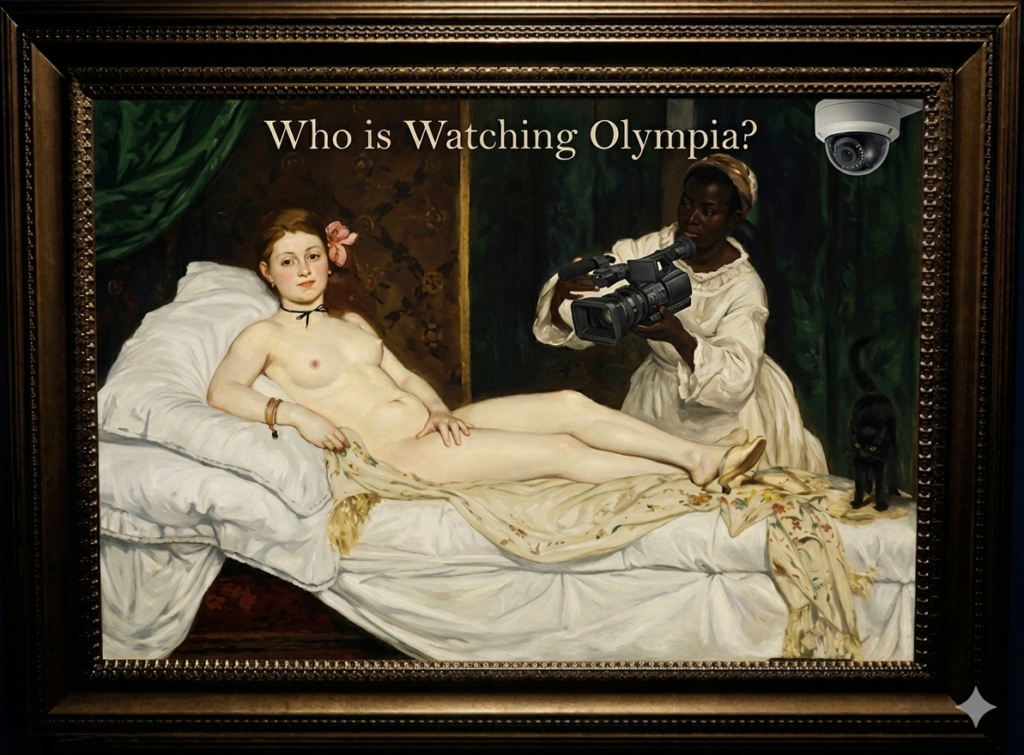
Who is Watching Olympia?
A woman stands in the heart of the city. She wears a small hat, her neck slightly arched back, eyes tilted upward toward the skyscrapers, or the sky, or perhaps nothing in particular. This is Cindy Sherman’s Untitled Film Still #21. In this series, Sherman creates dozens of photographs where she is simultaneously the director and the actress. The shots feel like scenes from a film that doesn’t exist. And yet, this woman carries herself as if someone is watching. As if the gaze already exists, even before the camera.
This pose is familiar to everyone. In the morning, the moment you step across your threshold and leave the house, your body undergoes a strange transformation – the spine straightens, the stride lengthens, the face arranges itself. No one has called out to you, but you already know: the street is a camera that is never turned off, constantly recording.
I am reminded of Michel Foucault and the Panopticon – that circular prison where the inmate never knows if they are being watched from the central tower, and thus behaves at all times as if they are under observation. Today, we no longer need that tower. It exists in the CCTV cameras mounted on Rustaveli Avenue, turning your every step into a digital trajectory. It’s in the subway car, where a black lens watches you while you sit hunched over your phone, connecting to Wi-Fi and surrendering your location and digital footprint in exchange. This is no longer mere surveillance; it is a discipline that burrows beneath your skin.
Control is most effective when you don’t notice it – or better yet, when it becomes a part of your comfort.
John Berger once said that a woman’s being was divided against itself: the one who acts, and the one who watches herself from the outside. In reality, the female body was the first Panopticon; long before Foucault, women already knew what it meant to live under a constant gaze and to perpetually curate themselves. CCTV simply “democratized” this experience – now, everyone lives the way women have lived for centuries.
We are all Sherman’s heirs, with one difference: we no longer know where the pose ends and our “true” selves begin. Even that “accidental,” seemingly unplanned shot captured for an Instagram story is as much a performance as Sherman’s photographs. We call this “authenticity,” though it is merely a well-rehearsed spectacle. The danger lies in the moment the pose penetrates so deeply that even in an empty room, without a camera or a mirror, you remain “in frame.” When you no longer know if a gesture belongs to you or to that invisible spectator sitting inside your own head. This is the ultimate victory of the Panopticon – not the camera itself, but the fact that even without it, you can no longer go dark.
The gaze is internalized. It is no longer a force imposed from the outside; it is our very optics.
Édouard Manet’s Olympia breaks this circle with a single gesture. The woman depicted on the canvas looks back at the viewer – with a direct, cold, and almost defiant stare. Olympia is posing, of course. She, too, is in the frame; she, too, is an object. But there is something in her gaze that disrupts your comfort: she knows you are watching. This knowledge is her freedom. She doesn’t respond with a smile; she simply sees you.
Emerging from the subway, as you stand on the escalator and catch sight of the camera mounted on the wall above, you instinctively fix your hair – again. Your fingers move mechanically. You don’t even need to look in a mirror – you already know exactly how you appear through that small, black lens.
About the Author
Ani Tenieshvili is a Tbilisi-based writer and creative artist working across media, culture, and visual communication. Her writing explores themes of love, emotional awareness, and social reality through an analytical lens, drawing on psychology and lived experience.
Follow her on Instagram for more content: @ani_tenieshvili_