Conversation with Tamara Kvesitadze: The Language of Impossible Unity
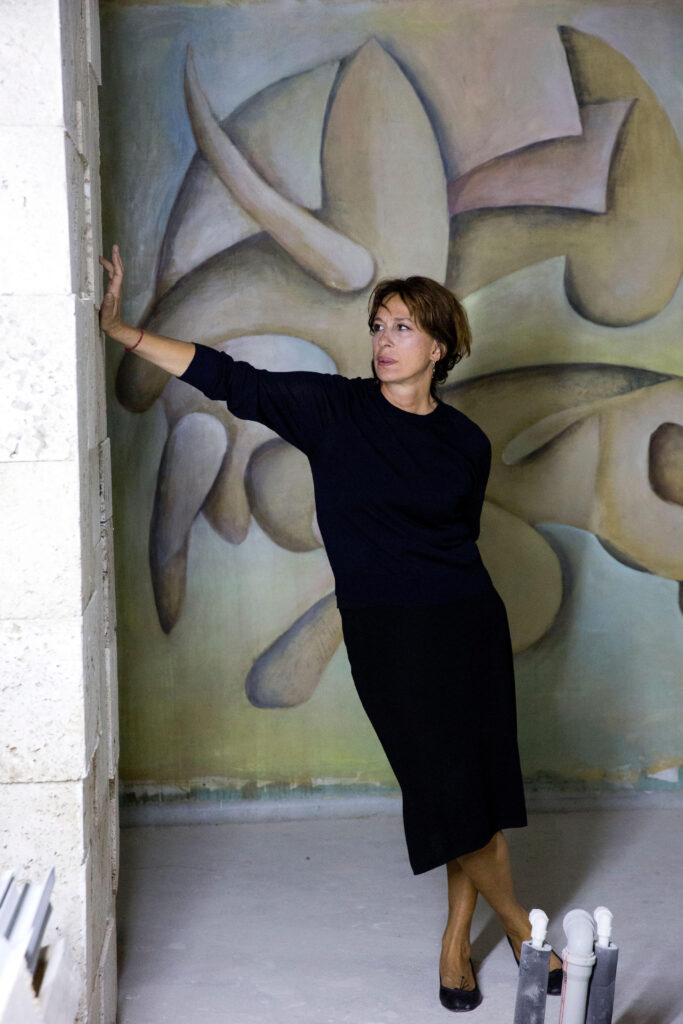
Louise Bourgeois once said that for her, sculpture was a form of redistributing memory – a way to transfer unbearable internal weight outside the body so as not to die from it. She wrote that if you do not give form to an emotion, it will give form to you, and that form will be far less habitable. Today, by one of the windows in Venice overlooking the water, I think about this sentence and about Tamara Kvesitadze – an artist who has been doing the same thing for years using different materials: she fragments the whole, only to later discover within those fragments the very wholeness that was lost. On the Batumi coastline, two of her figures constantly meet and yet can never stay together – a single body for a brief moment, then two again, then alone once more. It is a metaphor for perpetual motion and impossible unity. And as I watch the Venetian waters slowly, almost politely swallowing the city, I understand that Tamara’s works are not just about herself but about how we live within something that refuses to let us stay.
Tamara Kvesitadze is a Georgian artist from Tbilisi whose work spans sculpture and conceptual art. She is widely recognized as a leading figure in contemporary kinetic art with her practice revolving around the human body which is never fixed but always shifting. Her moving sculptures combine technical precision with a raw, almost ancient physical expression.
Tamara is currently presenting the exhibition Medea—Fragments of Memory at Palazzo Bragadin in Venice, on view from May 9 to October 31, 2026. Curated by Eka Enukidze and Hervé Mikaeloff, the show features a new body of work conceived specifically for the building’s historic setting. Internationally known for her large-scale kinetic installations and for representing Georgia twice at the Venice Biennale, Kvesitadze continues to explore themes of movement, transformation, and the fragility of human experience. The exhibition is supported by Kornfeld Gallery Berlin, Atelier Visconti, and the David Bezhuashvili Education Foundation.
Stepping beyond the exhibition, the following interview invites us into the artist’s thinking, where movement and memory take on a more personal dimension.
Louise Bourgeois wrote that form is a way of redistributing emotion, and if you don’t give internal weight a form, it gives a form to you. In your works, the figure almost never remains whole: legs are separate, the body rotates, the city collapses, paper tears. Do you feel that fragmentation is a form of redistribution for you? A way to make something that couldn’t be endured as a whole, habitable in fragments?
I want to start by saying that classical sculpture is a static form, and I have created numerous sculptures in this tradition. However, kinetic works gave us a new sense of breathing. They breathed a different kind of life into the sculpture. Kinetics gave us the opportunity to express a different state of form, its internal life. Our main desire was always to bring the form to life – we wanted the figure to breathe, to exist in time. A kinetic work is always tied to technical reality. Paata Sanaia and I have been working together for over twenty-five years. Paata is an engineer, and every time we conceive a form, it faces the necessity of change – the mechanics dictate their own terms. That’s exactly when the next stage begins as we think about how to cut the sculpture, so that it can move.
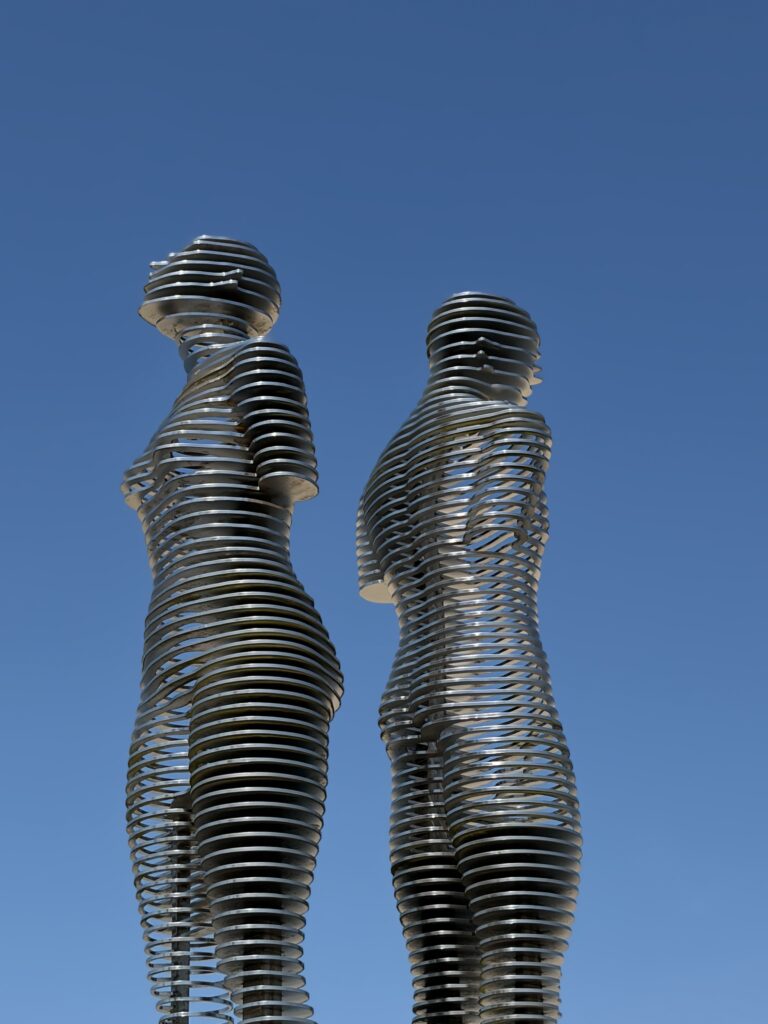
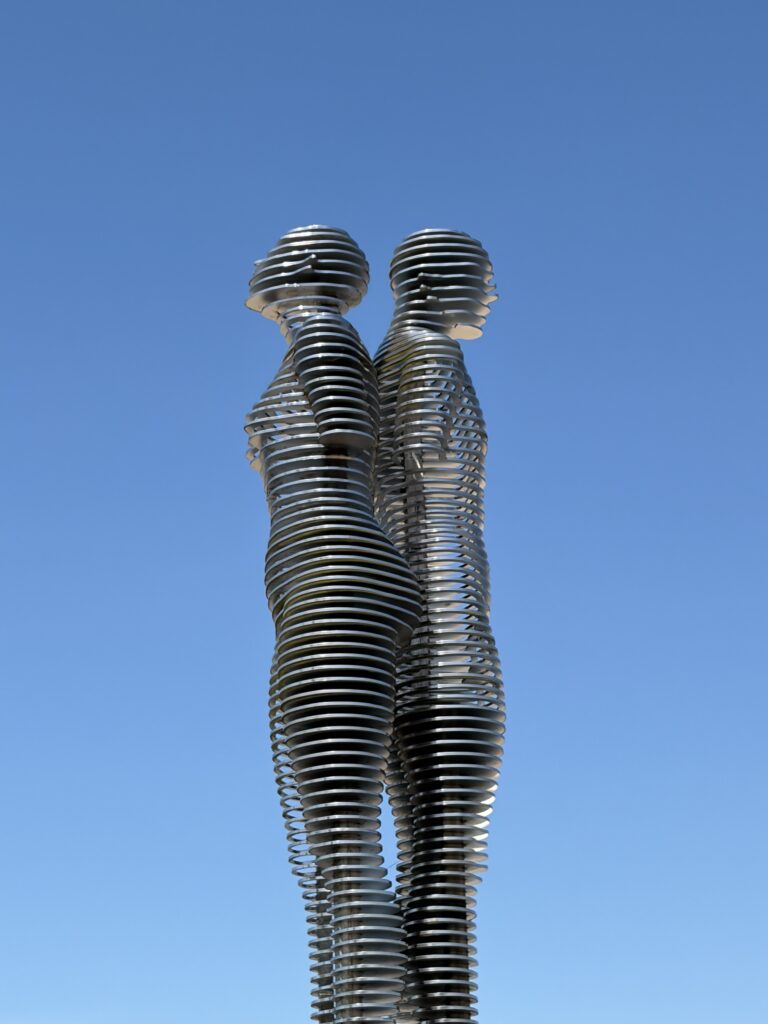
The statue of “Man and Woman” or else known as “Ali and Nino” on the Batumi coastline repeats the exact same gesture every day: approach, union, separation. This is not a failure but a rhythm. And yet, it is a rhythm in which the union constantly negates itself. When you were making this work, were you thinking that you were building a metaphor about love, or on the contrary, creating a form that negates the metaphor of love and offers us something closer to the truth?
Of course, love is the central metaphor in this work. I wanted to find a form in which two figures could transform into a single whole. However, this union cannot last long as it exists only for a very brief moment. In Eastern poetry and Sufi tradition, there is often the idea that a moment of love, anticipation, or loss can stretch into eternity. In Borges, there is the image of a moment containing infinity, and in Rumi, the idea of an encounter, a moment of meeting that might turn out to be longer than a whole lifetime. I think this is exactly what happens in the case of “Ali and Nino”: their union lasts only for a second, but emotionally, that second can become infinite. That is why this cycle is perceived differently: for some, it might become a state of enduring, almost infinite love, and for others, a moment that has already vanished.
© Ani Tenieshvili
© Ani Tenieshvili
Your exhibition Medea—Fragments of Memory takes place in Palazzo Bragadin. You once said it is “one of the most vulnerable embodiments of architectural memory.” You worked in Venice for a long time, walking in and out of the same rooms. What did you learn about Venice that photos and texts cannot tell us? What does a city know that loses a little piece of itself every day?
Many things connect me to Venice. For me, it is beauty, coldness, water, silence, and the sense of time slowly erasing everything alive. It is perhaps the only place where memory continues to narrate the past so vividly on a city-wide scale. I have participated in the Venice Biennale twice, and now, for the third time, my exhibition is being held parallel to the Biennale. However, my perception of Venice this time was completely different, perhaps because a lot of time has passed and I have changed: age, internal experience… or perhaps it is connected to the Medea project with the theme of disappearance and memory. When I first entered Palazzo Bragadin with the thought that an exhibition had to be done here, it immediately became clear that bypassing this antiquity, this visible presence of time, was impossible.
Your Medea is no longer a hero and a tragic figure but a state, a regime in which life continues without wholeness. This decision to turn Medea from a hero into a grammar is, to me, one of the boldest gestures of your long career. What was liberated in this decision when Medea is no longer required to be a victim or a perpetrator, but simply a form in which something continues?
Medea’s character always carried destruction, pain, love, fury, and at the same time, immense internal strength. It was important for me to express how all of this evolves over time, how the myth breaks down and shatters into pieces, how it changes meanings but still continues to live. For me, it is crucial that today Medea is no longer just a figure of myth. She remains a tragic character, but the form of this memory changes and transforms with time. That is exactly why we begin to perceive Medea not as a distant ancient image, but as a living being – one who lives among us with her modern fears and traumas.
Do you believe in perpetual motion and impossible unity? Your works often seem to me like a testament to this belief, but I might be wrong. Maybe it is not a belief, but something else: allowance, resignation, or simply, the only language left to us when all other hopes depart. Which word would you choose?
I want to believe in the impossible and in perpetual motion. And even when I think it is impossible and yet it might still be my goal at some point, you just start moving on an untrodden path, or toward the light you intuitively feel. Toward where you feel you must go. Art is born in that exact second when you walk in this direction and get lost there. This disappearance is connected to time. And I think that for a split second, you truly get there. I believe every artist has been there at least once.
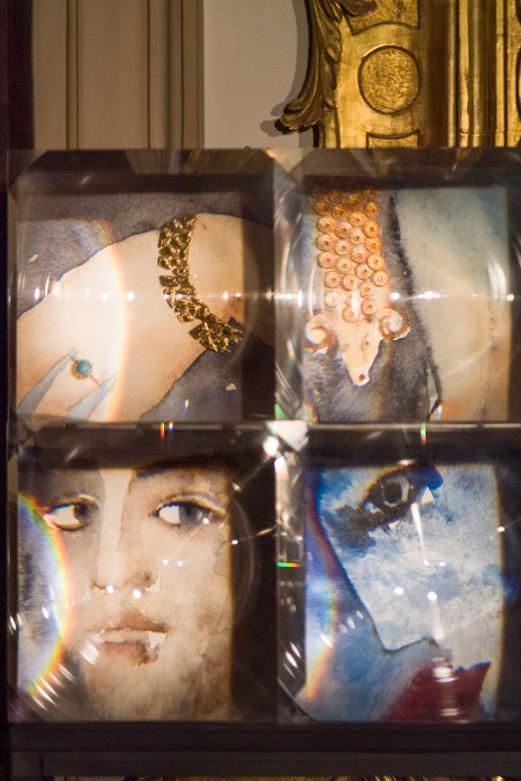
© Artwork by Tamara Kvesitadze exhibited in Palazzo Bragadin, Venice
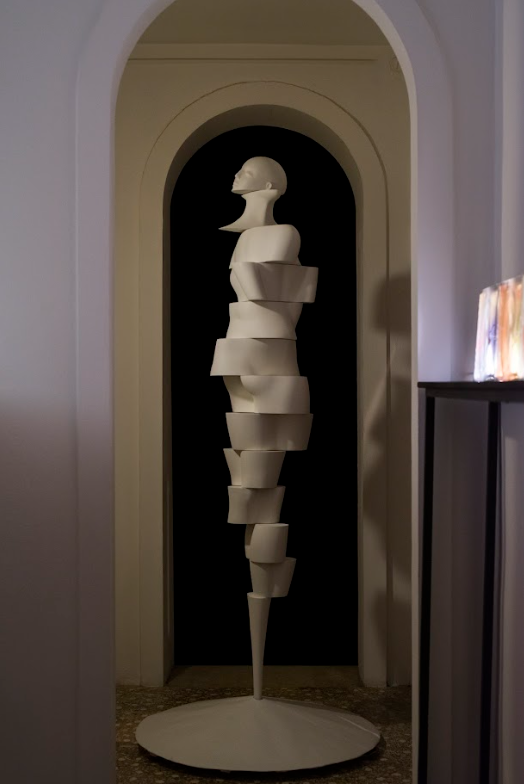
© Artwork by Tamara Kvesitadze exhibited in Palazzo Bragadin, Venice
Louise Bourgeois once said that sculpture for her was a form of redistributing memory. Today, by the same window where I stood at the beginning, I think that perhaps the redistribution never ends, that an emotion, once transferred into form, does not stay there but returns again, demands to be transferred again, demands a new body again. Perhaps this is the only thing that is truly eternal – not the motion itself, but its incompletion. The two figures in Batumi meet again, Tamara’s Venetian city rises and collapses again, the Venice beyond the window shrinks by another millimeter. And I think of the question that has followed me from the beginning, which I only now dare to ask out loud: do we, people who always lack someone in life, believe in perpetual motion and impossible unity? Or is it simply the only language we have left after the other hopes have abandoned us?
About the Author
Ani Tenieshvili is a Tbilisi-based writer and creative artist working across media, culture, and visual communication. Her writing explores themes of love, emotional awareness, and social reality through an analytical lens, drawing on psychology and lived experience.
Follow her on Instagram for more content: @ani_tenieshvili_