Bettie Buio: Control and Surrender in Burlesque and Shibari
Control is something you can construct, rehearse, refine, and repeat until it looks effortless.
Surrender is different. It cannot be fully planned. It happens gradually, often unpredictably, and once it begins, it is difficult to reverse.
For Letizia, who performs as Bettie Buio, these are not abstract ideas. They are two distinct practices she moves between: Burlesque and Shibari. One is built on control. The other on surrender. One exposes the body. The other exposes the feelings.
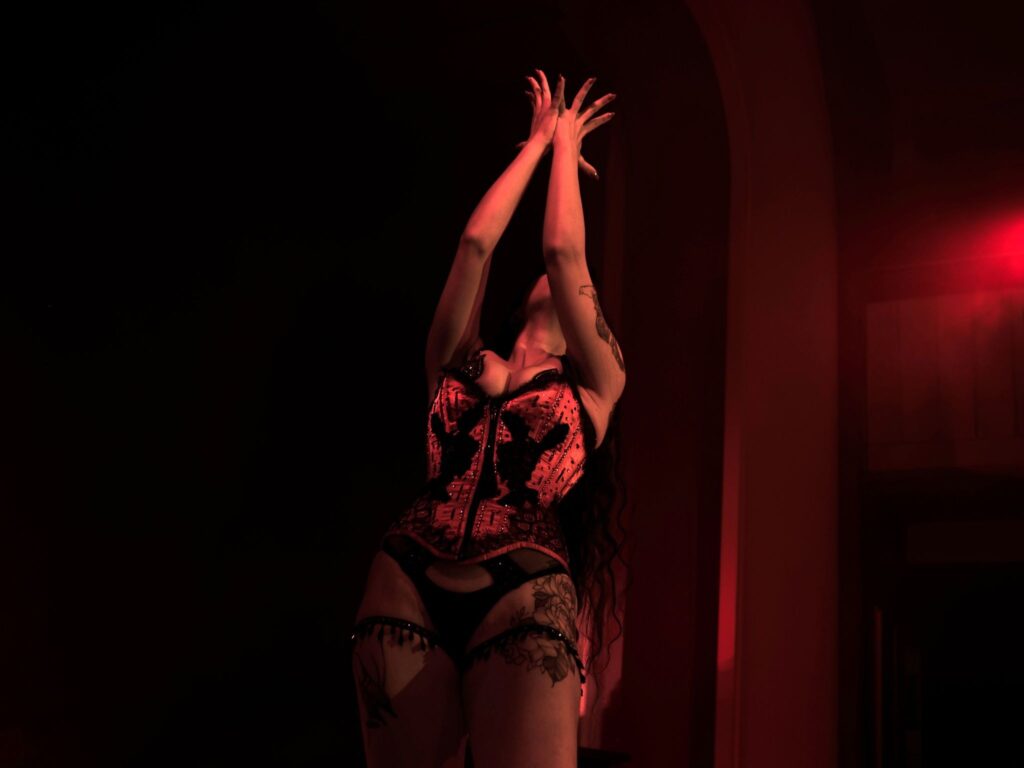
In Burlesque, vulnerability is physical while control central. It is about standing in front of an audience and allowing your body to be seen, evaluated, and interpreted. Every movement is intentional, every gesture timed, every layer removed with precision: when to look, when to react, when to laugh, when to stay silent. The performance is constructed, but what it reveals is real: posture, confidence, hesitation, and often the insecurities performers carry into the space.
Training reflects this. It is not only about choreography. Performers develop control over how they present their bodies, how they hold tension, how they direct attention, how they sustain presence even when they feel exposed. For many, this is the most difficult stage. The first months are often described as intense, particularly for those who are already aware of their bodies in critical ways.
© Jana Marie Knotova
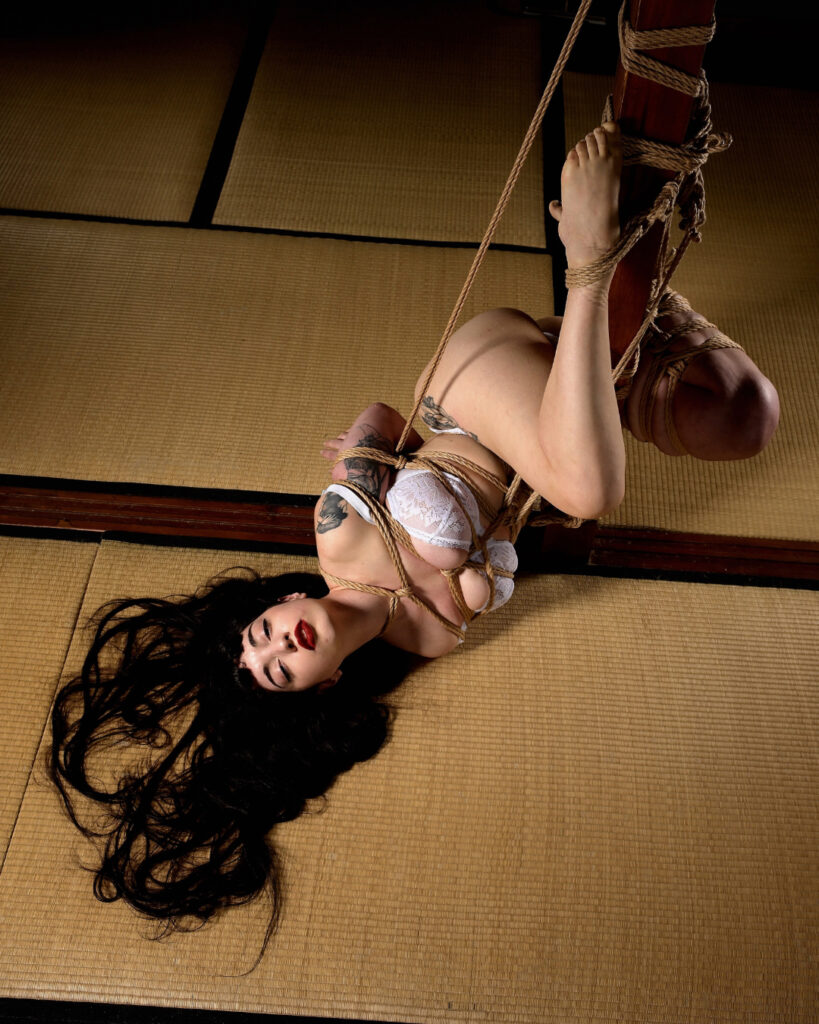
Shibari operates differently. Here, vulnerability is not primarily about how the body looks, but about what feelings emerge when control is removed. The body is placed into positions that limit movement, and control is gradually removed rather than demonstrated. The experience depends on interaction rather than choreography, and on a dynamic that cannot be entirely predicted. What emerges is not performed in the same way. It unfolds.
Physically, the practice involves restricting the body in ways that are safe but not natural. Movement becomes increasingly limited, and the experience shifts from physical sensation to a broader psychological state. It is not defined strictly by pain, but by a controlled form of discomfort that develops over time.
As the body becomes constrained, something else becomes more visible. Reactions are no longer fully managed. Emotions surface without the same level of control that performance allows. Participants may cry, resist, release tension, or become still. These responses are not choreographed. They are experienced in real time.
So, if Burlesque is about choosing what to show, Shibari is about confronting what cannot be hidden.
© Araki
Bettie Buio’s path into these practices reflects that contrast. Originally from southern Italy, she moved to Milan at eighteen, leaving behind a more conservative environment. Her first entry point was the BDSM community, where she tried practicing Shibari for the first time. What started as exploration became a long-term practice.
After COVID, she began looking for something that allowed for a different kind of expression. That search led her to Burlesque. She enrolled in a specialized academy in Milan, where training follows a multi-year structure.
According to Bettie, Burlesque scene does not exist in isolation. In Milan, it overlaps closely with drag and other performance communities, sharing spaces and audiences. These intersections create a broader environment where performance becomes a tool for experimentation and visibility.
As Bettie continues to develop her work, she performs regularly in Italy and abroad, with appearances ranging from local shows to private events. She has also begun participating in international festivals, including a recent performance in Prague at the Bohemian Market, part of a Bohemian Burlesque Festival that brings together performers from across different countries.
Let us introduce to you Bettie Buio – a performative artist of Shibari and Burlesque.
Hi! Thanks for meeting me. Can you please introduce yourself?
Hi, I am Letizia, though my stage name is Bettie Buio. I started studying Burlesque right after COVID and made my debut in 2024, so I am still relatively new to the community.
Where did you study Burlesque?
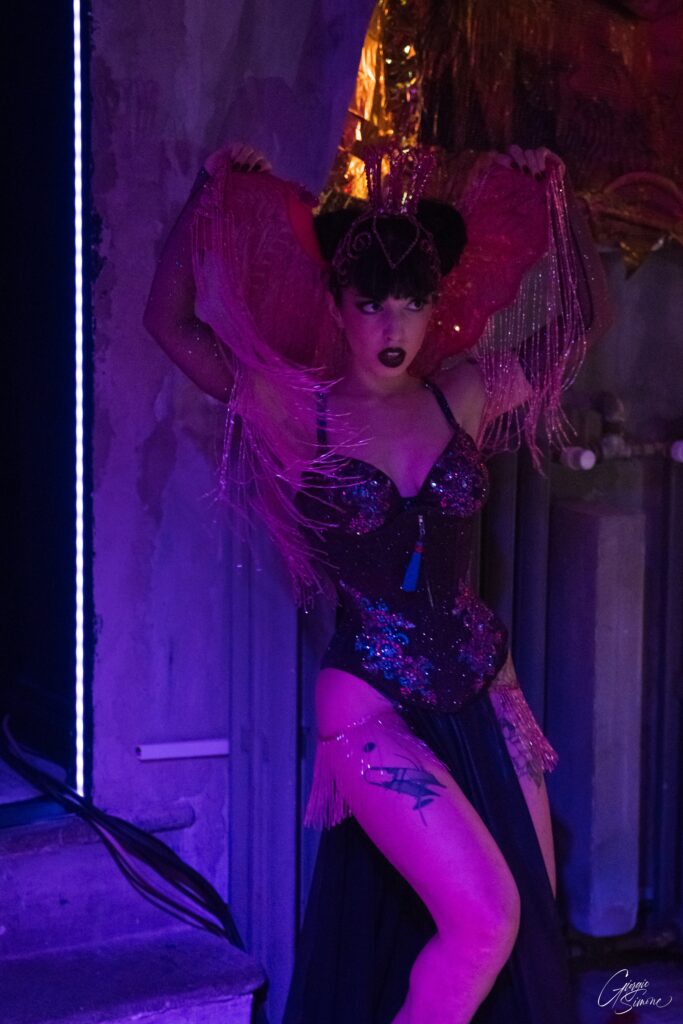
I am currently studying at the Rouge Academy here in Milan, which is specifically dedicated to Burlesque. It is one of those things that, if you are not already familiar with, you would not even expect to exist. However, there is actually a whole community of Burlesque performers and many schools devoted to this style of arts. There are also shorter courses you can take, lasting a few months, but the program I am following at the academy spans several years.
© Giorgio Simone
Several years? Can you walk me through the program?
Yes, it is very structured. I am currently in my fourth year. It functions almost like a masterclass program, where different teachers are invited to lead workshops. Classes are quite different from traditional dance training. They focus heavily on poses and walks, specific ways of moving and holding yourself. From there, you begin working with props. For example, in the first year, we worked with gloves and robes. Then we gradually introduced boas into performances. In the second year, the focus shifts more toward corsets, as well as strip elements and accessories like belts. From the second year onward, you also begin preparing for a final show. Together with your teacher, you choose the props you want to bring on stage. For instance, in my first year we developed a “secretary” themed act: we studied how to remove a shirt, change footwear, and incorporate a chair into the performance. Now, in the third year, we are working with more complex props like balloon dances. You cover yourself with balloons attached to a harness and then pop them in sync with the music. It is not just about popping them but also about timing and understanding when each moment should happen which can be little chaotic and overwhelming for the performer. We are also working with veils, similar to those used in belly dance. Burlesque often borrows elements from other dance traditions such as Oriental dances, blending them together into something unique.
How did you get into Burlesque?
I am originally from southern Italy, from a very close-minded environment. When I moved to Milan at eighteen, I became curious about what was out there and what I could explore. My first exposure to alternative communities was through BDSM, where I discovered Shibari and began studying rope work. I have been practicing it with the same partner for about eight years. However, after COVID, I felt the need to explore something different. Shibari is inherently relational as it involves another person, shared expectations, and mutual direction. However, there were things I wanted to express that Shibari was not giving me entirely. That is when I decided to try a burlesque class. I went through the initial selection, found it incredibly intriguing, and decided to stay.
So interesting. Maybe, as you already mentioned Shibari, you can tell me more about it
Shibari is the practice of tying or being tied with rope, and there are many different styles. It has Japanese roots. However, there was also a movement of Western, especially American occidental, practitioners who were working with ropes as well.
It is not an extremely ancient practice in the way we understand it today. The modern form of Shibari started around the beginning of the twentieth century, before World War II. If we look at its development in waves, there were significant moments between the 1940s and 1950s up to the present day. During that time, there were also magazines that featured images of people being tied, especially images of women.
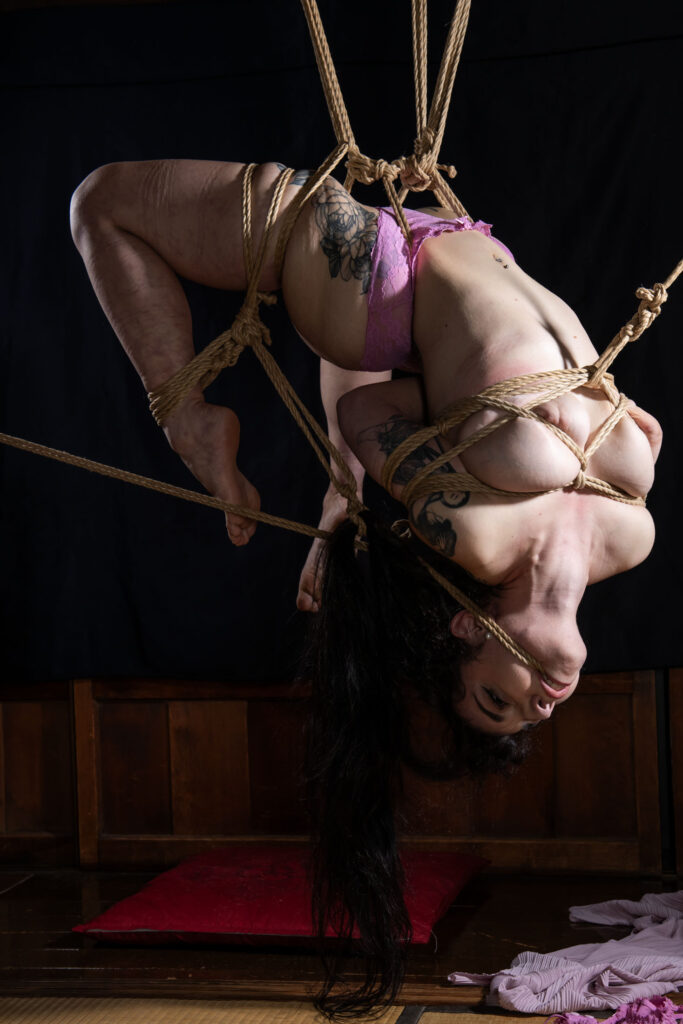
Today, the practice varies depending on the style. Some people approach it as something similar to meditation or yoga. Others approach it as performance art, or even in a circus-like context. One of the styles I practice comes from a Japanese lineage associated with Naka Akira, known in the community as Naka style. This style is very widespread because it blends BDSM elements, meaning that it is intended to bring a sense of suffering into the scene, with a strong aesthetic component. It is more focused on the session itself, on the interaction, and also on elements of endurance and constraint. It is very beautiful to watch and focuses heavily on the interaction between the person tying and the person being tied. It can be described as poetic, and it is visually interesting.
There are also other styles that are more symmetrical, or more focused on visual composition. For example, there are artists like Hajime Kinoko, who creates installations using red ropes, with people being arranged in sculptural shapes. He has presented work at events such as Burning Man. That approach is much closer to visual art, and you can clearly see how different it is from more interaction-based styles of Shibari.
© Norio Sugiura
Is it painful? Because it looks quite painful to me.
It can be painful, but it is more about a sense of suffering rather than direct pain. Physically, it is challenging because your body is placed in positions that are not natural. For example, in Naka-style, the first tie usually involves the hands. From a symbolic perspective, if a person has free hands, they are not fully tied.
In this style, the hands are tied behind the back, which restricts movement and locks the shoulders in a position that, while safe if done correctly, is not natural for the body. As the tying continues, the body becomes more and more constrained. The purpose is that, progressively, you lose the ability or the desire to move. You reach a point where you let go completely.
And how does it feel to give up control?
Many people, especially women, become very drawn to this experience. Often, they are unsure at first, but once they try it, it can become addictive. In both, Burlesque and Shibari, you are allowed to be yourself, but in different ways. The key difference with Burlesque is that it is constructed. You build a performance, you decide when to laugh, how to move, how to tell a story. Even if it is personal, it is still structured. With Shibari, you cannot fully construct what happens. You cannot hide your emotions. You are forced to deal with them in real time. If something is too intense, you must learn how to handle it or communicate without panicking. You are also allowed to express emotions that are often suppressed in society. You can cry, you can scream, you can let go in ways that you might not even allow yourself when you are alone. It creates a shared emotional atmosphere between the participants and the audience. Watching someone in that state of vulnerability can be very powerful.
The first time I watched a Shibari performance, I was very struck. The model was crying, and I realized that it was not something to be ashamed of. It was something being celebrated. The audience shares that moment, even if they do not know the full story.
Okay, now I get it. So basically, you do two kind of arts – one that gives you control and one that makes you lose it. Interesting. So, do you perform Shibari to public as well?
Yes, although not very frequently now. It depends a lot on my partner and on practical factors, such as having a proper structure for suspension. For example, we recently moved, and we are currently building a structure with beams in our new house to allow for suspension. It is a rented space, so it requires careful planning. There are also communities across Europe, often in major cities, where people gather to practice and perform. My next performance should be in June.
What kind of venues host these performances?
It depends. In Milan, there are dedicated spaces and schools where events take place. Outside the community, performances can happen in clubs or artistic venues. However, Shibari performances are different from other types of shows. A full session can take at least 45 minutes, because you need time to begin, to tie, and to develop the interaction. It is slower and less immediately dynamic than other forms of performances.
You mentioned you come from close-minded environment. Do your family members know about your work in performance arts?
No, and that is a conscious decision. I do not have a negative relationship with my family, but I prefer to keep this part of my life separate. In my experience, in more traditional environments, people often do not try to understand. They form an opinion quickly, without engaging deeply.
At a certain point, I decided that I do not owe an explanation for everything I do, and that not everyone needs to know every aspect of my life. That said, it is not hidden. My Burlesque Instagram profile is public. If it were to become a much bigger part of my life, I might communicate it more openly, but for now I maintain that boundary.
Yes, I totally understand. I recently started doing drag and I am also very selective with who I share this information. Just to avoid unnecessary headache.
Oh, you started doing drag? So interesting. Where do you usually perform?
Thank you, I am quite a beginner, but I love the thrill. I usually do it in Don’t Tell Mama. I think you also performed Burlesque there.
Yes, I did.
So, is performative arts your full-time job?
No. I studied product and digital design, and I work full-time in a consultancy firm. I am in a position where I can manage my workload efficiently and maintain a good balance. This allows me to dedicate time to Burlesque and other activities. Occasionally, when I have performances abroad, I need to take time off, but so far it has been manageable.
Do your colleagues know about it?
Some of them do, especially those I am close to. It is a relatively young workplace, and I feel comfortable sharing with certain colleagues. However, I still maintain professional boundaries. I do not feel threatened if others were to find out, but I also do not feel the need to share everything.
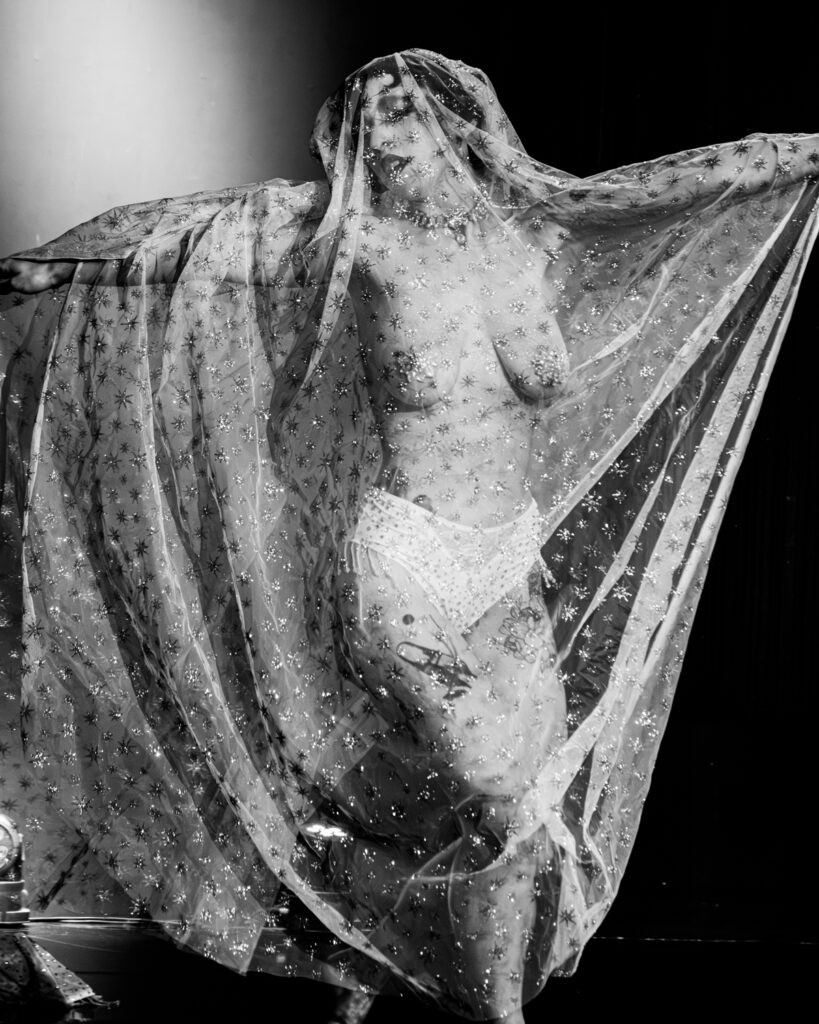
© Bari Martina
What does your stage persona Bettie Buio represent?
To be honest, I am still defining it. Each act helps shape my stage identity. At the moment, it leans toward a darker, more obscure aesthetic. This is something I have been drawn to since high school. However, I am also trying to incorporate other elements. For example, I am working on an act that is entirely pink but still carries something darker within the storytelling. It is about balancing these elements.
In Burlesque, it is important to develop a recognizable identity, especially if you perform internationally or at festivals. Some performers focus on a single style, a specific era, or even a single color.
Can you describe your first Burlesque performance?
My first performance took place during the academy’s final show at Zelig Theater in Milan, which is a beautiful cabaret venue with a strong cultural history. I performed in two group acts and one solo. Backstage, there is always a strong sense of community. Even if you do not know everyone deeply, there is a feeling of family. We call each other “sisters” and “brothers.”
I did not feel nervous at all but suddenly, before going on stage, I had about ten minutes where I felt completely frozen. But once I stepped on stage, the energy from the audience was incredible. Some of the performers invited their families, even their grandparents which was so cute. In Burlesque, the audience is encouraged to cheer and react, which creates a very supportive environment. People usually get pre-show explanation on how and when to cheer and applaud. It is especially meaningful because performing Burlesque involves showing your body, which can feel vulnerable as we all do have insecurities. Being cheered in that moment is a very powerful experience.
Yes, a cheering audience really creates the thrill. It would be so sad if the audience was silent as it makes you think you are doing a bad job.
Exactly but at the same time, you have to learn how to deal with that. Sometimes the audience is not very reactive, but that can also be because they do not know how to respond. So, you need to find ways to continue doing your performance regardless.
The thing is that the first months of school are rough. Even if you are used to performing, in class you must stand in front of a mirror for one hour, holding specific pose and observing yourself.
Even in a dance class, you do movements, but here you have to stand still, look at yourself, feel yourself, and let the audience perceive your body. It is not only about the dance, but also about you. So, the first months are difficult for everyone, especially for people with non-conforming bodies. Everyone struggles, but for someone who is very aware of their weight, height, or other aspects of their body, it can be particularly intense. Some people leave after this period.
Sounds quite intense. But I am happy you did not quit. When is your next Burlesque performance?
Thank you (laughs). Next weekend. I am performing on Friday, Saturday, and Sunday outside Milan. Then I have another performance the following week at a wedding. It will be the first wedding I perform at, together with another colleague from the academy. I hope everything goes well.
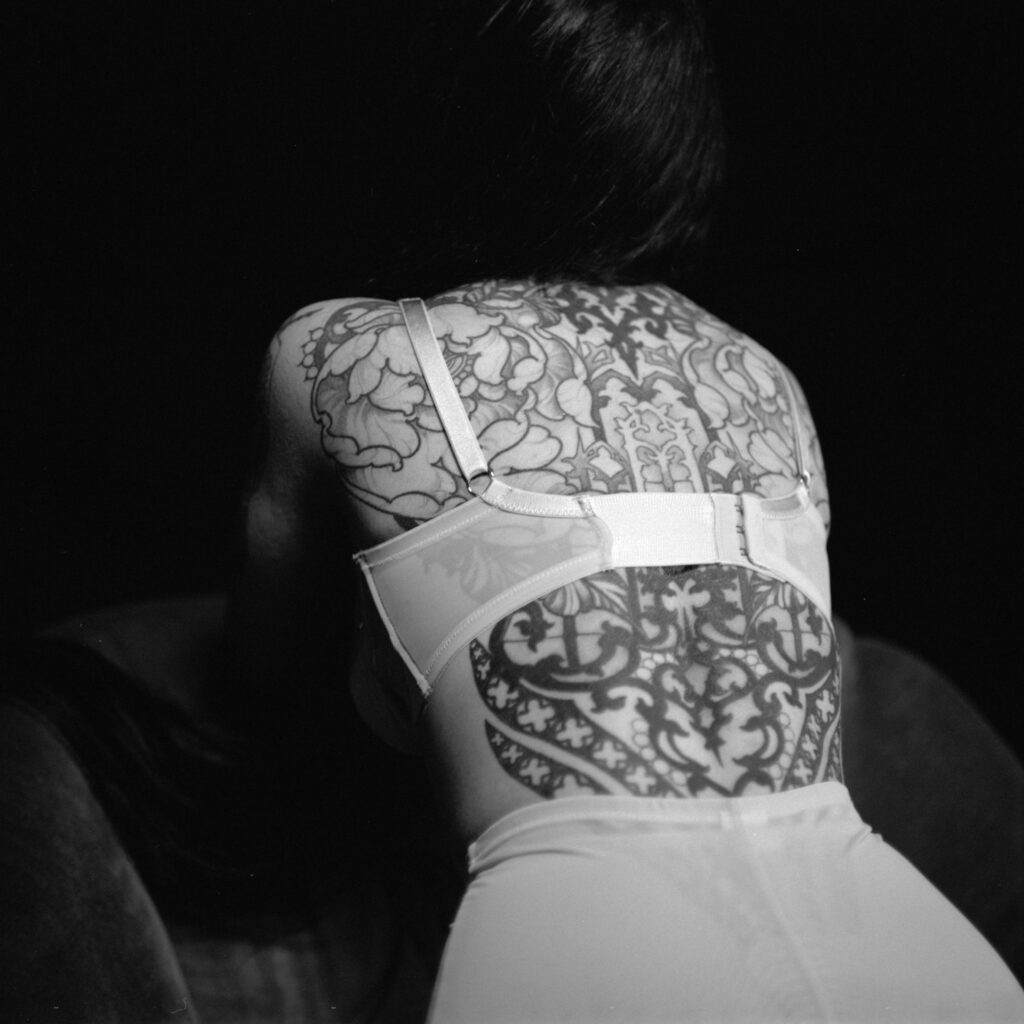
© Ema Kuroko
I am sure it will. I saw on your Instagram that you performed at a Bohemian Burlesque Festival in Prague. How was it?
Basically, there are festivals throughout the year. You can apply, and there is a committee that selects the performers. I applied to Prague and performed at the Bohemian Market, which is the beginner section of the festival.
The Prague festival itself is very large. It runs across four nights. I performed in the afternoon, not during the main evening shows. It was really interesting because selected performers are usually very good. So, you can watch an entire night with ten or twelve performances, and all of them are strong. It is a very enriching experience.
For me, it was my first festival abroad. Also, you often find people you know there. For example, we were three friends traveling from Milan to that festival. And then my teacher also performed in one of the main evening shows.
The most important part, however, is meeting performers from all over the world. I am a bit shy, so I am not someone who networks a lot, but you still end up getting to know certain people because they are prominent in the community. For example, in Barcelona there is a couple who organizes a well-known festival, and in Italy there are also key figures. It felt like a completely new world to me. It was very exciting.
Do you know that Dita Von Teese is coming to Milan?
Yes, she is coming in April. I already bought a ticket.
Really? I am going too. It has been my dream to see her since I was a child.
Yes, she is amazing. She took a style of Burlesque that was very niche and brought it back into the mainstream. I think we really owe something to her for making Burlesque visible again.
You know, I also found a burlesque school and cabaret in Tbilisi. It is called Gazette and I know about it because one of the girls I know was invited as a guest there.
Oh wow, I had no idea. I will definitely check it out, thank you! What would you say are challenges in doing Burlesque?
Although there are many different spaces and schools that try to be as open and inclusive as possible, Burlesque still exists within society. When you want to be booked, it often depends on what you bring to the stage. It can be easier to get booked if you have a more conforming body, or if you perform a glamorous showgirl style, or have certain characteristics. However, there are many environments that actively try to move away from that and create more inclusive spaces.
Burlesque is also very connected to drag. In Milan, for example, my teacher Ella and the drag community are quite close. Our shows are often hosted by the drag queen La Fay.
Ah yes, she hosts shows in Don’t Tell Mama on Wednesdays.
Exactly, so next time you perform, let me know.
I will definitely do. Thank you so much for taking time and talking to me. It was very interesting.
Thank you for being interested. It was a pleasure.
Thanks to Bettie Buio for sharing her experiences and thoughts on Burlesque and Shibari. Check out her Instagram to see more of her art: @bettie.bio
Thanks to Araki (@araki_2.0), Norio Sugiura (@suguiuranorio), Jana Marie Knotova (@janamarieknotova), Giorgio Simone (@giosimone), Ema Kuroko (@ema_3.8) and Bari Martina (@martina.bari) for the photographs.