Detour Toward Fulfillment: A Night at Essaim
There are nights that begin by accident. The kind that are not planned or anticipated. They simply arrive because something in you refuses to go home yet. Essaim happened like that for me. I was at the dinner, having conversations around life, satisfaction with it, or lack of it, and the metrics by which we decide whether we are “fulfilled” or not. One of the friends-of-a-friend said, almost casually, that his life felt full lately. I couldn’t say the same. I live in Paris, yes, and things are comfortable, but I don’t feel that sense of fullness yet. I’m close to it, maybe, but not quite there.
Something in me has recently shifted. I am interested in clubs again. Not as escape. More as a reflection of where I am now. My ways of seeking pleasure or meaning tend to change, as I change, and right now the club is where things make sense. The music feels right. Something real, something physical. A pulse that doesn’t need to be explained. Dance as a temporary form of meaning.
So when Essaim came up in conversation, a place I had been meaning to go for months, it stayed with me. After dinner, dissatisfied with both the food and the proposed continuation of the night, I took a bike in the rain and headed home. But the music in my headphones pushed me elsewhere. Fulfillment is never guaranteed, but curiosity can be a direction to the ways of getting it, at least. I changed my route and rode toward Essaim.
© Essaim Paris
The line was long. Tickets sold out. The staff gave a talk about harassment and boundaries, firm, clear and human. A good sign. The queue consisted of mostly young groups of well-dressed Parisians, talking and laughing with the kind of energy you usually see on a “Parisian terrace”, casual, social, outward, performative. Behind me, a girl kept bumping into me, repeatedly, without any acknowledgement. She was one of those types, who treat space as something to be taken rather than shared. I decided the door policy would reveal something. If she was let in, that would say something about the place. If she wasn’t, that would say something too. She wasn’t. And I was pleased.
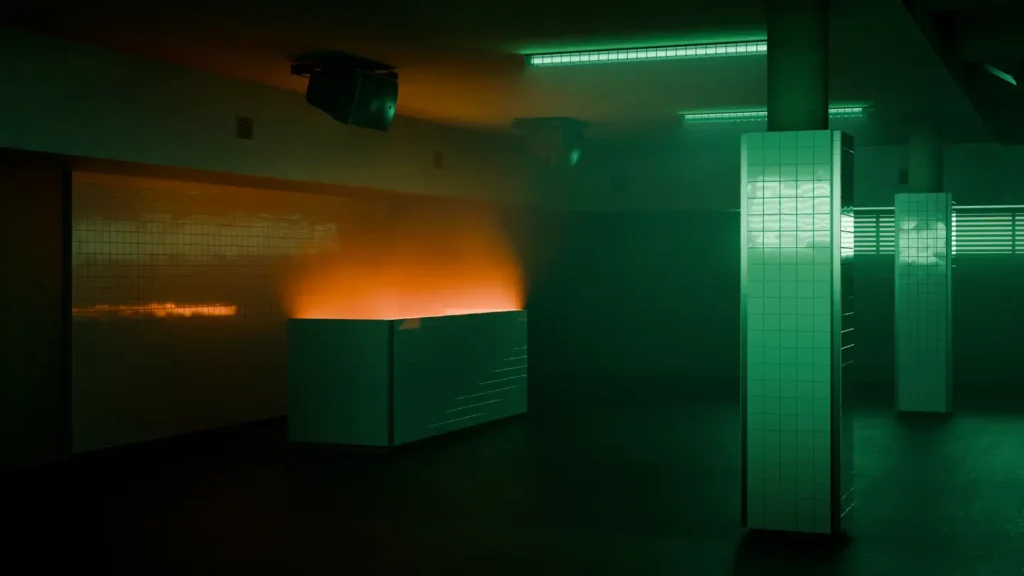
Inside, Essaim was intentional. The lighting was dark but not theatrical. Slow washes of color moved as if the room was breathing, giving the space a steady rhythm of its own. The sound system was excellent, warm low end, clear mids, the kind of sound you feel. And there was a scent, eucalyptus, clean, almost therapeutic. Even the soap matched the atmosphere. Menstrual pads and toiletries were available in the bathrooms, openly, without spectacle. A quiet gesture of care, handled with intention.
What struck me most was the sense of care. Everything felt considered: the flow of the room, the balance between light and shadow, the absence of visual noise. Nothing screamed for attention. Nothing was overdesigned. It was a space that trusted you to arrive as you are and understand what to do with the night.
The music was the night’s anchor, and the lineup delivered. Amina, Konduku, and Octo Octa each built something gradual, emotional, patient. No push for attention. A sense of progression, a narrative, which is rare. Each set felt connected to the one before it, not competing but extending the mood. At times the room seemed to hover in a perfect equilibrium: movement, sound, warmth all aligning. I could have easily stayed until noon.
But parts of the crowd felt split.
Some people were fully present, dancing with intention, eyes closed, rhythm coming from somewhere internal. Others treated the dance floor like a social stage, having full conversations in the middle of the room, taking selfies, filming themselves, flashes cutting across faces for no reason. Nothing breaks immersion faster than being reminded that you’re being watched.
At one point, the same group from the queue — the friends of the girl who kept bumping into me — appeared beside me. Not because the room was full, it wasn’t, but because some people occupy space by force rather than presence. After a few minutes of jostling and insistent proximity, I stepped away. Not out of defeat, but disinterest. The flow had already been interrupted.
And yet, I would go back.
Essaim is one of the few clubs in Paris actively trying to build something real: care, curation, emotional continuity, an environment that treats the night as a shared ritual rather than content.
But the crowd needs refining, not stricter doors, just clearer expectations. Dancing is a form of presence. Not everyone knows how to be present.
Fulfillment might still be out there. Maybe not as a revelation, but simply as a night where everyone remembers why they came.
I will return. But next time, I’ll be more deliberate about where I stand.