It Was Just an Accident: Footsteps of Fear and Power in Iran and Beyond
by Sopho Kharazi
Note. If you are reading this, be prepared for spoilers. That said, I highly recommend stopping here, watching the movie, and then coming back.
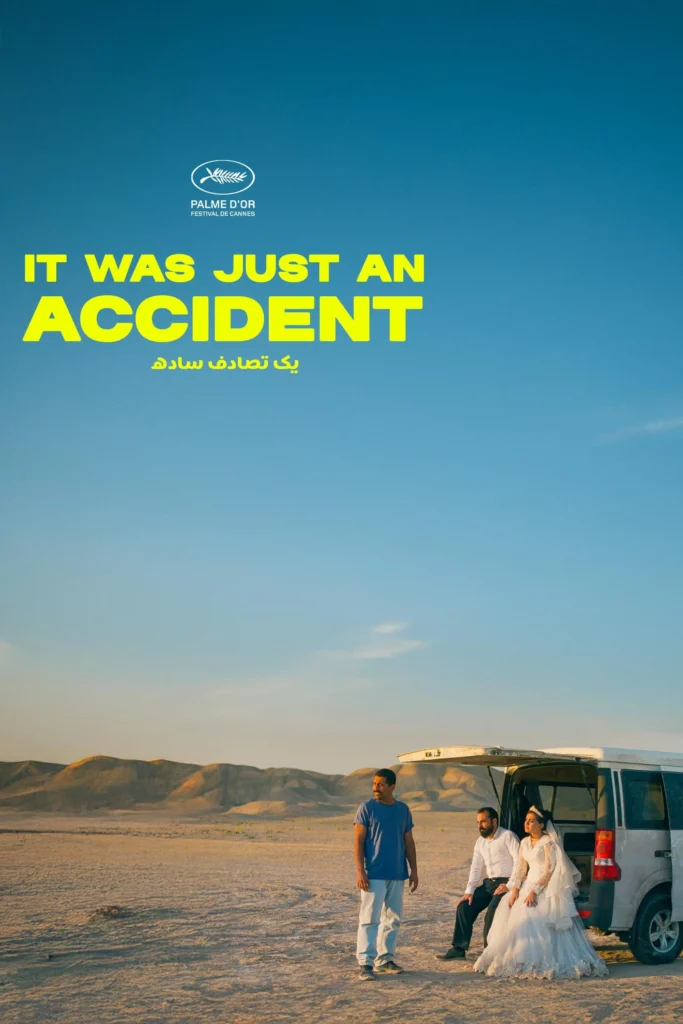
I recently watched Jafar Panahi’s new film It Was Just an Accident. It left me with goosebumps, and as I sat alone at home afterward, I found myself half-expecting the sound of a prosthetic leg approaching me.
I have noticed that many Persian films follow a very distinctive narrative pattern. For the first half hour, the viewer has almost no idea what is happening. Gradually, the story begins to unfold, and the ending is often left open, allowing the audience to interpret the fate of the characters. This film is no exception. At first, we witness chaos: noise, confusion, and an increasing number of characters entering the story. Meaning emerges not through direct exposition but through conversations between characters, as we slowly piece together fragments of information and construct the story ourselves rather than having it handed to us by the director.
The film follows a group of former political prisoners in Iran who capture one of their former interrogators and torturers, Eghbal, known as “Peg Leg” because of his prosthetic limb, which makes a distinct squelching sound when he walks. As the film progresses, we learn that Eghbal lost his leg while fighting in Syria, an act framed as fulfilling the will of God. The squelching sound becomes his defining feature, as the prisoners had been blindfolded throughout their imprisonment and torture, able to recognize him only by that sound. The central dilemma facing the group is whether to kill Eghbal out of revenge or to let him go. Beyond the physical and psychological suffering they endured, imprisonment has clearly devastated their families as well, with Vahid’s – the main character – fiancée having committed suicide. What complicates this moral equation is that the film opens by showing Eghbal driving with his pregnant wife and young daughter, presenting him within a family dynamic. During this nighttime drive, he accidentally runs over a dog. When he sees the injured animal, his reaction conveys sadness, grief, and distress, offering no immediate hint that this man might derive pleasure from harming others.
The film often feels chaotic and, at times, exhausting, as the group argues loudly and repeatedly about what should be done with Peg Leg. Yet the final two scenes make the endurance worthwhile.
The Tree
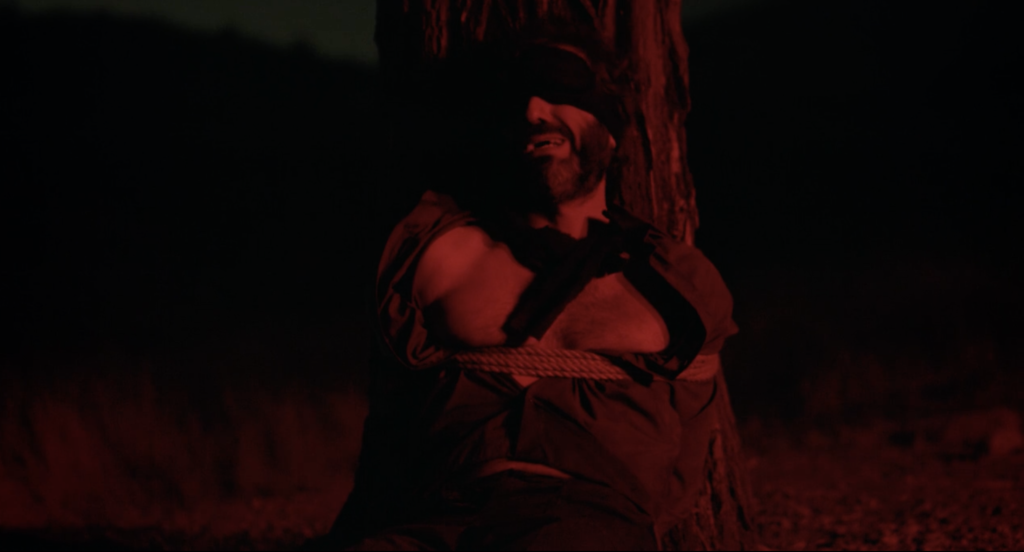
The scene shows Peg Leg tied to a tree, blindfolded, unaware of who has kidnapped him or how his fate will unfold. It is a true thirteen-and-a-half-minute tour de force. Filmed in a single shot, it moves through shifting emotional registers: anger, arrogance, frustration, sorrow, grief, and finally atonement. At first, Peg Leg performs the role of the unbreakable strongman, insisting that he does not care whether he lives or dies because what matters most is his service to God. His rhetoric is pure regime propaganda, eerily echoing the language used by ISIS to justify its violence in Syria. He repeatedly threatens, “Let me go, I will anyways find out who you are and come after you,” while accusing his captors of being unpatriotic and anti-Islamic for opposing the regime. During this exchange, we learn that Vahid was imprisoned and tortured simply for protesting alongside fellow factory workers who had not been paid for eight months. As the dialogue intensifies, Eghbal suddenly breaks down. He begins to cry, asking for forgiveness, and confesses that he tortured them because their refusal to confess made him feel small and insignificant. Their silence, he admits, felt like mockery similar to his classmates laughing at him when he was bullied at school.
This is the moment where one could spend hours unpacking questions of power, insecurity, and authoritarianism. I choose to analyze the birth of this character through two different theories.
First is the theory of the Authoritarian Personality. In 1950, Theodor Adorno, together with Else Frenkel-Brunswik, Daniel Levinson, and Nevitt Sanford, published The Authoritarian Personality, a study aimed at understanding how individuals with “potentially fascistic” personality types are formed. The research traced deep insecurities and prejudices back to childhood experiences and examined how these vulnerabilities could later be exploited by authoritarian regimes. Through clinical interviews and projective psychological tests, the researchers analyzed their subjects’ personalities in considerable depth. To measure authoritarian tendencies, Adorno’s team developed the F-scale, with “F” standing for “fascist.” Individuals who score highly on this scale typically exhibit a cluster of interrelated traits, including a rigid adherence to traditional middle-class values alongside authoritarian submission, marked by uncritical obedience to idealized moral authorities within one’s in-group. This is paired with authoritarian aggression: a tendency to condemn, reject, and punish those who violate conventional norms. High scorers often resist introspection and emotional sensitivity, favoring hard mindedness over imagination or empathy. A strong preoccupation with power and toughness is also common, emphasizing hierarchies of dominance and submission, identification with powerful figures, and exaggerated displays of strength and masculinity.
In the case of Peg Leg, we learn that he was a victim of bullying. Bullying, especially in childhood, does not merely hurt feelings. It fundamentally shapes how power is experienced in the body. Chronic humiliation produces a fragile sense of self-worth, hypersensitivity to disrespect, and a compulsive need to reverse power relations at all costs. As Adorno’s theory of the authoritarian personality suggests, such individuals do not seek equality but invulnerability, because power offers temporary relief from feelings of smallness and shame. These unresolved insecurities are frequently rewarded by authoritarian regimes, which prioritize obedience over conscience and elevate individuals who equate cruelty with strength. Those who are easily humiliated, who interpret disagreement as disrespect, and who require absolute control to feel safe are not marginalized but promoted. Within these systems, authoritarian submission upward is paired with aggression downward, making cruelty feel not only justified but necessary. Over time, the regime becomes populated by individuals whose inner world is governed by anxiety and the fear of no longer being feared.
The second theory I use for the analysis is from Erich Fromm’s Escape from Freedom where he argues that modern freedom, while liberating individuals from external authority, often generates anxiety, isolation, and a sense of insignificance. Rather than fully embracing autonomy, many people seek to escape this psychological burden. This framework offers a powerful lens through which to understand Peg Leg, whose authority functions less as political conviction than as emotional refuge. Like Fromm’s model of individuation, the character has severed earlier ties but failed to develop a stable inner self, leaving him dependent on external power for meaning. He escapes freedom through authoritarianism by merging with the regime, through destructiveness by annihilating those who threaten his fragile sense of control, and through automaton conformity by reducing himself to a mere function of the system rather than a moral agent. His cruelty is not incidental, it is regulatory, shielding him from the anxiety of autonomy and restoring his sense of significance in a world that would otherwise make him feel small.
The Footsteps
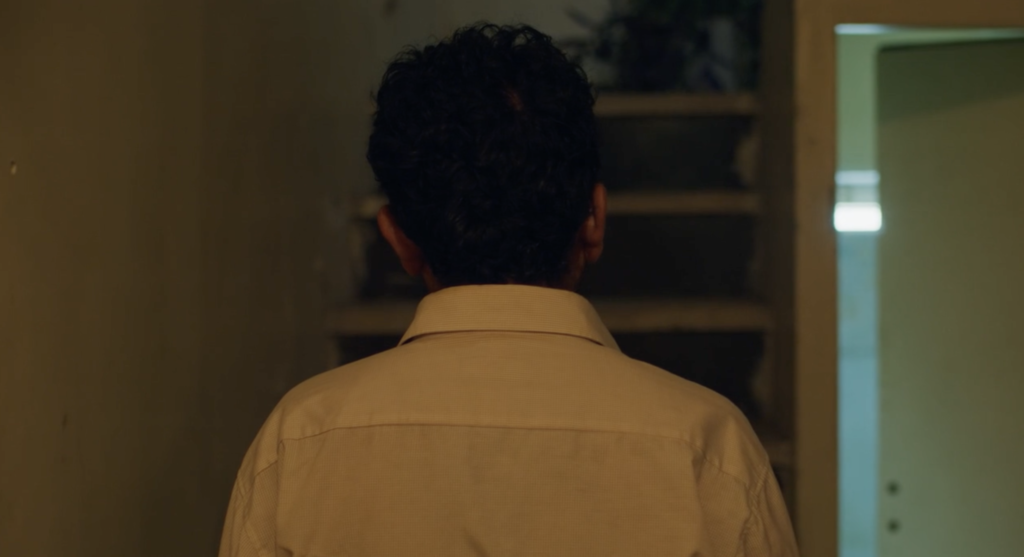
Peg Leg is ultimately set free after his moment of atonement, left alive but blindfolded and tied to the tree. The final scene takes place sometime later and shows Vahid packing his belongings to move out of his mother’s house. He appears genuinely happy, and the atmosphere is once again chaotic, but this time in a cheerful and hopeful way. Suddenly, as Vahid steps back into the house, he freezes in place, struck by a familiar sound: the squelching noise of Peg Leg’s prosthetic limb. The camera remains fixed on the back of Vahid’s head as he does not turn toward us or toward the sound. We hear the prosthetic leg grow louder and then fade away, which I interpret as Eghbal approaching Vahid and then leaving. This is where the film ends, abandoning the audience at the edge of a cliff, uncertain about Vahid’s fate. Will he be imprisoned and killed? Will his entire family be executed by the regime? Or will he somehow be spared?
My interpretation of this scene is rooted entirely in power dynamics. Eghbal spares Vahid not necessarily because Vahid spared his life, but because Vahid helped Eghbal’s wife while Eghbal was being held captive. In other words, I doubt that Eghbal’s moment of atonement reflects a genuine moral reckoning. Rather, that encounter made him feel small once again, prompting him to seek out Vahid to reassert his dominance. The unspoken message seems clear: I know who you are. I know where you live. I can find you whenever I want, and I can do whatever I want to you. The purpose is not punishment, but fear, ensuring that Vahid lives in a constant state of anxiety. This mirrors the condition of ordinary citizens in Iran, and in authoritarian regimes more broadly, where power is maintained not only through violence, but through the perpetual fear of its possibility.
The film’s final image echoes uncannily with Michel Foucault’s concept of the Panopticon, a system of power in which control is maintained not through constant violence but through the permanent possibility of surveillance. In authoritarian regimes like Iran today, power does not need to strike everyone. It only needs to remain imaginable. Citizens learn to regulate themselves, to anticipate punishment, to live as if the guard might always be watching. And yet, despite this architecture of fear, Iranians continue to protest. Students, workers, women, artists who are fully aware of the risks, arrests, torture, and death that may follow. This is what makes their resistance so extraordinary. To protest under such conditions is not ignorance of danger, but a conscious refusal to let fear dictate existence. Panahi’s film captures this tension with devastating precision: the regime’s power lies in its ability to make footsteps echo even when no one appears, but the courage of the people lies in continuing to move, speak, and resist anyway. In this sense, It Was Just an Accident is not only a meditation on trauma and authoritarianism, but also a quiet tribute to a society that, despite living under constant surveillance and threat, continues to insist on dignity, agency, and the possibility of freedom.