The Strange Machinery of the Self
by Gvantsa Garmelia
I’ve always been fascinated by dreams. As a child, dreams felt like small riddles, left on the bedside table of my unconscious mind for the morning version of me to decipher. I’d lie there, trying to solve them, not because I thought they carried messages from another world, but because they felt like something my mind was doing on purpose, even if I couldn’t yet parse the language.
During the day, the mind competes with everything: expectation, performance, social choreography, the unbearable brightness of reason. But at night, it sheds its uniform. It returns to something raw and original: images without etiquette, emotions without explanation, truth without narrative polish.
Freud wanted dreams to be secrets. Jung wanted them to be symbols. Neuroscientists insist they are a kind of emotional housekeeping. All of them circle the same idea without quite naming it: Dreams are the brain’s original processing language.
Just the system speaking in its native syntax when the conscious user interface shuts down. If waking thought is an email written in complete sentences, dreaming is the raw code behind it: compressed, symbolic, nonlinear, but deeply structured. Understanding your dreams means understanding parts of yourself.
A few dreams have stayed with me long enough that they feel like chapters from a personal mythology. They mark the beginning, middle, and something-like-a-hypothetical future of my emotional life.
The Childhood Home
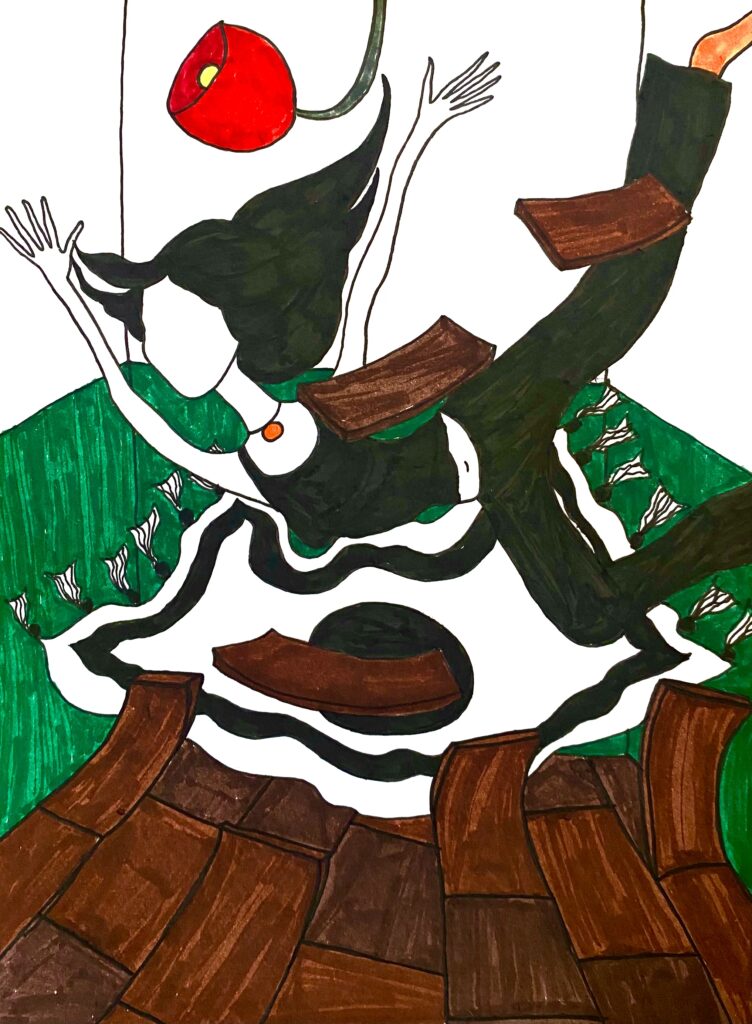
When I was little, I had a recurring dream that took place in the house I grew up in. I was on the second floor, standing on a patterned rug. Without warning, the wooden floorboards would begin to disassemble themselves, plank by plank, like the architecture was giving up on its own structure.
Even the staircase would dissolve, becoming a cascading spine of wood. The rug lifted, carrying me above the collapse. I remember the jolt in my chest, the brief drop like the stomach-sink on a theme park ride. But then the calm arrived. Always the calm. The dream ended not in terror, but in suspension. Me hovering above a broken world, safe only because I had learned to detach from its weight.
It doesn’t take a therapist to see the metaphor. When your childhood environment is emotionally unstable, you develop a kind of aerial survival instinct. You rise above rather than sink. The rug was my portable safety, the kind you carry with you. I stopped having that dream shortly after I moved out of my hometown, as if my psyche acknowledged that the original architecture no longer defined me.
© Sopho Kharazi
The Tsunami
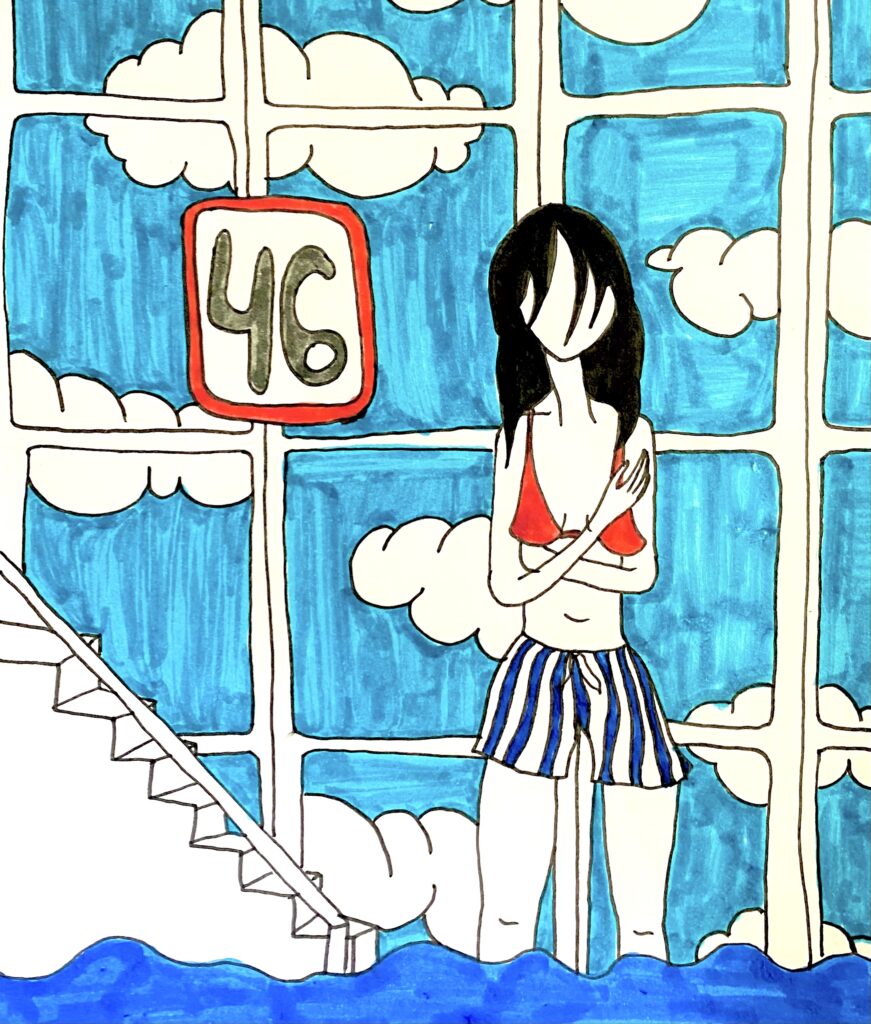
There’s a second dream, also recurring, that arrives in adulthood. I’m on a beach. People are playing volleyball. There’s sunlight, laughter. And then the sea retracts in that impossible way water does before disaster, pulling itself inward before rearranging into a towering wall. A tsunami. No time to think, only to run. I sprint up a skyscraper staircase, floor after floor, the water chasing behind me like some prehistoric force. I never freeze. I don’t panic. Survival enters my body like muscle memory. Eventually I reach the forty-sixth floor, where the water rises to my knees and stops. People around me drown. I do not. I feel relief first, then sadness, and then the strange detached calm of someone who expects to survive. For years, the dream ended that way, me alone, knee-deep in aftermath. Then one night, something shifted. As I stood in the water, someone reached out a hand. Someone who had survived just enough to need mine. I woke up before I knew whether I helped.
Therapists would call this dream a threat rehearsal, a simulation of emotional overwhelm. But the meaning hides in the coping strategy, not the wave. Running upward is how I handle emotion in waking life too: First, I seek altitude, perspective, a safe vantage point. Only once I’m stable do I feel capable of reaching for solutions or anyone else. That outstretched hand wasn’t a symbol of danger, it was a marker of change. A relational impulse entering a dream that had always been solitary. The staircase is my mind modeling a coping strategy; the hand that appears years later is the system testing whether I’m ready for connection.
© Sopho Kharazi
The Sky Made of Crystals
The third dream is the most beautiful.
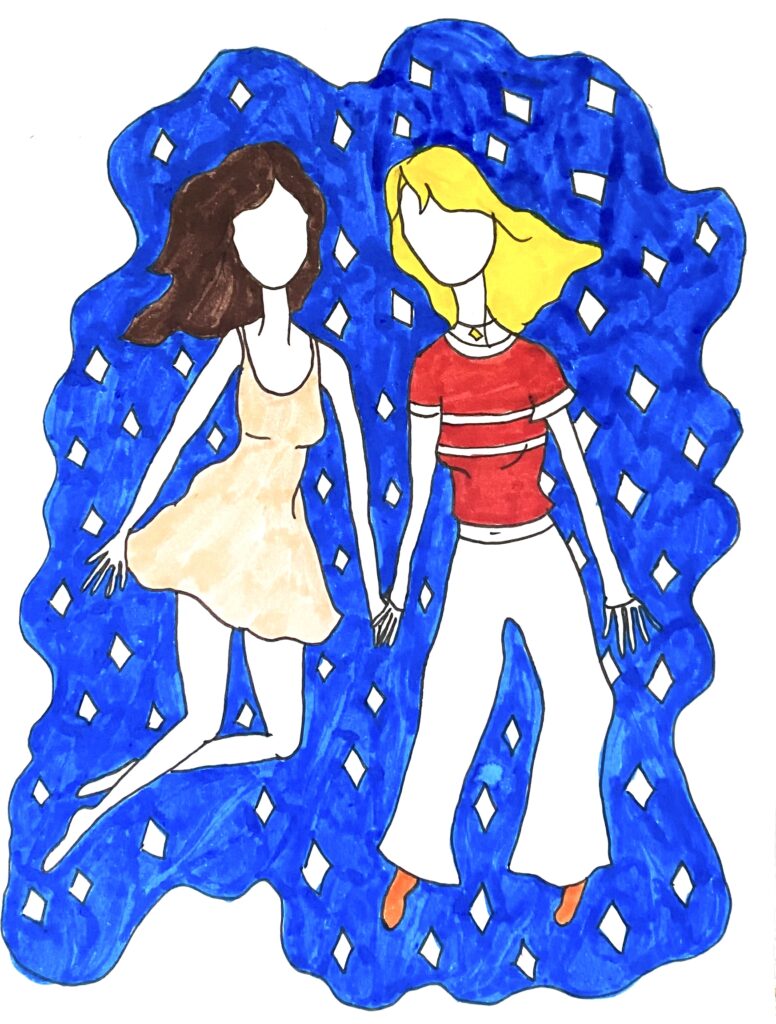
It feels like it belongs to a different dimension of me. In this dream, one I’ve had only once, but remember with unshakable clarity, I’m hovering above a quiet, manicured American suburb at night. I’ve never been to a real one, but the dream conjures it with cinematic accuracy: circular streets, trimmed lawns, houses asleep in the blue summer dark. Someone is holding me and we drift above the ground in silence.
The sky is full of stars, but that’s not the surreal part. The air is filled with thousands of iridescent, floating crystals. Tiny, translucent drops suspended like data points in a world too soft and too magical to be real. The entire scene feels like a manifestation of safety and wonder layered on top of ordinary life. A moment of perfect emotional equilibrium. The kind of dream your system gives you when it’s trying to show you something, not a fear this time, but a longing.
This dream processes longing: my psyche generating a prototype of safety and intimacy my waking life hasn’t provided yet. It’s not fantasy, it’s emotional rendering, my system showing me an available configuration of connection.
© Sopho Kharazi
My quest of understanding my psyche through my dreams have led me to explore different schools of thoughts.
First, there’s Freud. Dreams as Disguised Desire
Freud believed dreams were the “royal road to the unconscious,” a nightly performance in which the psyche hid forbidden wishes beneath layers of symbol. According to him, dreams never say what they mean. They smuggle content past the internal censor the way smugglers hide diamonds in cakes.
He thought everything in dreams was coded: (long objects = masculine desire boxes, rooms, containers = feminine desire, staircases = sex, water = birth). I’m sure you see the pattern here.
Today, most of Freud didn’t survive peer-review, but the core idea did: dreams reveal what we don’t say out loud.
Not because of penises or repression, but because emotion slips through imagery when it’s too dense or too complicated to articulate.
Freud was wrong in specifics, right in spirit.
Then, there’s Jung. Dreams as Messages From the Deep Self
Where Freud saw disguise, Jung saw instruction. For him, dreams weren’t trying to trick you, they were trying to guide you.
He believed dreams contained: archetypes (universal human patterns), symbolic landscapes, figures representing different parts of the psyche, clues about where the personality is unbalanced.
He thought dreams pulled us toward integration, toward becoming whole, by dramatizing what we are ignoring.
A shadowy figure meant you were avoiding a part of yourself.
A house represented the psyche’s structure.
Water symbolized the collective unconscious.
Light represented insight.
Jung is beloved by artists because he believed that dreams make art before you do.
Neuroscience defines Dreams as Emotional Regulation & Memory Organization
Neuroscientists typically roll their eyes at Freud and Jung, but their version is equally poetic in its own way.
In this model, dreams are:
- the hippocampus reorganizing memory
- the amygdala recalibrating threat
- the cortex stitching fragments
- neural pathways being pruned or strengthened
- emotional experiences being “filed”
- identity being updated
During REM sleep, the brain becomes extraordinarily active, except the logic centers.
This is how you get impossible physics, nonlinear stories and symbols instead of sentences
The brain is doing maintenance, but maintenance with flair.
Dreams are like a software update disguised as a music video.
More niche, but the Threat Simulation Theory interprets Dreams as Survival Training
This one is less famous but incredibly compelling.
Researchers like Antti Revonsuo argue that dreams evolved as a biological rehearsal space, a simulator for danger.
Your ancestors outran tigers in dreams long before they outran them in life.
This is why nightmares are common, recurring danger dreams occur during stress, how we often wake at the climax and why you dream of running, falling, drowning, being chased. The purpose isn’t prophecy, it’s practice. The brain says: let’s test fear in a safe environment so we’re faster tomorrow.
Cognitive Dream Theory, Dreams as Problem-Solving
This theory argues dreams help us think in ways impossible when awake.
Creative, nonlinear, associative thinking is strongest in sleep. We tell each other “sleep on it” all the time. Maybe there’s science behind it. This is how the periodic table appeared to Mendeleev in a dream; McCartney heard “Yesterday” in his sleep and Larry Page dreamt the idea for Google.
Dreams are not just emotional, they are high-order cognition freed from realism.
The brain probes on what if we put two unrelated ideas together? It’s cognition without the bureaucrat.
The Activation-Synthesis Model, Dreams as Random Sparks We Make Meaning From
This theory, created by Hobson & McCarley, argues that dreams are mostly noise.
During REM sleep, the brainstem fires randomly; the cortex scrambles to interpret these signals.
The brain, desperate for narrative, weaves a story from chaos the way you’d invent meaning in tea leaves.
In this theory dreams don’t mean anything, you are the one giving meaning and that the brain hates randomness, so it creates order. Even if dreams are noise, the interpretation is truth. Your brain tells you about yourself while trying to explain its own static. This theory sounds cynical but actually affirms this: meaning is made, not found.
Cultural & Anthropological Perspectives, Dreams as Social, Ancestral, and Communal
In many cultures, dreams aren’t personal at all. In some Indigenous Amazonian groups, dreams are considered messages from ancestors. In ancient Greece, dreams were treated as visits from gods. In Bali, dreams are communal: people share them each morning the way we share news. In medieval Europe, dreams were moral tests. In Islamic tradition, dreams can carry spiritual significance and are discussed with scholars.
These cultures see dreams not as internal mechanics but as conversation, participation in something larger.
Anthropologists argue that Western psychology treats dreams too individually.
I don’t know if I agree with the communal nature of dreams, but it sure does make for one of my favourite dinner topic conversations.
The dreaming mind is the most inventive part of the human brain.
Mary Shelley dreamt of Frankenstein’s creature.
Henri Rousseau painted jungles he only walked through in sleep.
James Cameron dreamt of the Terminator, a chrome skeleton rising from fire.
C. S. Lewis dreamt of the faun in the snow that became Narnia.
Dreams combine unrelated concepts with reckless confidence.
They remove the editor.
They disregard feasibility, coherence, and common sense.
In dreams, the mind stops asking,
Should this exist?
and simply asks,
What if it did?
Every dreamer has a private symbolic language.
Some people dream in fire.
Some in shadows.
Some in strangers’ faces.
I dream in water, never modest, always catastrophic.
Not a puddle, but an ocean.
Not a wave, but a wall.
I dream in elevation, floating rugs, skyscrapers, hovering suburbs.
My survival, always upward.
I dream in architecture, houses that unmake themselves, cities that rearrange beneath me.
And I dream in light, crystalline atmospheres, impossible skies.
Dream symbols don’t generalize.
They personalize.
They tell you what your system finds non-negotiable.
For someone else, a tsunami would be fear.
For me, it is overwhelm.
For someone else, a suburb would be boredom.
For me, it is safety imagined but not yet lived.
For someone else, a floating rug would be whimsy.
For me, it was my first coping mechanism.
Dreams speak in symbols because symbols survive sleep better than sentences.
A Lesser-Known Truth
There is a fact rarely mentioned in dream literature: dreams tend to show up precisely when the psyche is ready for them. Trauma dreams often arrive years after the event, when the nervous system finally has capacity. Growth dreams appear before conscious growth has begun. Recurring dreams evolve quietly when internal landscapes shift.
Dreams have impeccable timing.
If waking life is the story we perform for others, dreams are the story we whisper to ourselves.
The version without choreography. The version without fear of being misunderstood.
Dreams are not messages from elsewhere. They are the nightly minutes when the mind remembers itself. Not the self shaped by biography, ambition, disappointment, or the slow erosion of adulthood, but the original one. The one that existed before language, before performance, before fear.
The mind speaks.
We sleep.
And if we are lucky, when morning comes, we remember a sentence or two of what it tried to say.
About the Author
Gvantsa Garmelia is a Georgian marketer, creative producer and a literary translator living in Paris. She loves all and any form of storytelling, but words are her one true love.
Follow her on Instagram: @gvantsasi